Tamil Nadu
Jump to navigation
Jump to search
Tamil Nadu ([ˈt̪ɐmɨɻ ˈn̪aːɽɯ] ( listen), "Tamil Country"), formerly Madras State, is one of the 29 states of India. Its capital and largest city is Chennai (formerly known as Madras). Tamil Nadu lies in the southernmost part of the Indian subcontinent and is bordered by the union territory of Puducherry and the South Indian states of Kerala, Karnataka, and Andhra Pradesh. It is bounded by the Eastern Ghats on the north, by the Nilgiri Mountains, the Meghamalai Hills, and Kerala on the west, by the Bay of Bengal in the east, by the Gulf of Mannar and the Palk Strait on the southeast, and by the Indian Ocean on the south. The state shares a maritime border with the nation of Sri Lanka.
The region was ruled by several empires, including the three great empires – Chola, Chera, and Pandyan empires, which shape the region's cuisine, culture, and architecture. The British Colonial rule during the modern period led to the emergence of Chennai, then known as Madras, as a world-class city. Modern-day Tamil Nadu was formed in 1956 after the reorganization of states on linguistic lines. The state is home to a number of historic buildings, multi-religious pilgrimage sites, hill stations and three World Heritage sites.[10][11][12]
Tamil Nadu is the eleventh largest Indian state by area and the sixth largest by population. The economy of Tamil Nadu is the second-largest state economy in India with ₹16.05 lakh crore (US$230 billion) in gross domestic product after Maharashtra and a per capita GDP of ₹186,000 (US$2,700).[4] Tamil Nadu has the sixth highest ranking among Indian states in human development index.[6] It was ranked as one of the top seven developed states in India based on a "Multidimensional Development Index" in a 2013 report published by the Reserve Bank of India.[13] Its official language is Tamil, which is one of the longest-surviving classical languages in the world.
Tamil Nadu
| |
|---|---|
     
From top, left to right:
Great Living Chola Temples, Shore Temple, Ranganathaswamy Temple Srirangam, Our Lady Of Snows Church, Marina Beach and Nilgiri Mountain Railway | |
| Anthem: "Tamil Thai Valthu"[2] (Invocation to Mother Tamil) | |

Location of Tamil Nadu in India
| |
| Coordinates: 13.09°N 80.27°ECoordinates: 13.09°N 80.27°E | |
| Country |  India |
| Formation | January 1950, 26† |
| Capital and Largest city | Chennai (Madras) |
| Districts | 35 |
| Government | |
| • Body | Government of Tamil Nadu |
| • Governor | Banwarilal Purohit |
| • Chief Minister | Edappadi K. Palaniswami (AIADMK) |
| • Deputy Chief Minister | O. Panneerselvam (AIADMK) |
| • Legislature | Unicameral (234)[1] |
| • High Court | Madras High Court[2] |
| Area | |
| • Total | 130,060 km2 (50,220 sq mi) |
| Area rank | 11th |
| Population
(2011)[3]
| |
| • Total | 72,147,030 |
| • Rank | 6th |
| • Density | 550/km2 (1,400/sq mi) |
| Demonym(s) | Tamil, Tamilian, Tamilar |
| GDP (2018–19) | |
| • Total | ₹16.05 lakh crore (US$230 billion) |
| • Per capita | ₹186,178 (US$2,700) |
| Languages | |
| • Official | Tamil[5] |
| • Additional official | English[5] |
| Time zone | UTC+05:30 (IST) |
| ISO 3166 code | IN-TN |
| Vehicle registration | TN |
| HDI (2017) |  0.708[6] high · 6th |
| Literacy (2011) | 80.33%[7] |
| Sex ratio (2011) | 996 ♀/1000 ♂[8] |
| ^# Jana Gana Mana is the national anthem, while "Invocation to Mother Tamil" is the state song/anthem. ^† Established in 1773; Madras State was formed in 1950 and renamed as Tamil Nadu on 14 January 1969[9] | |
| Symbols | |
| Emblem |  |
| Language |  |
| Song |  |
| Dance |  |
| Animal |  |
| Bird |  |
| Flower |  |
| Tree |  |
| Sport |  |
 listen), "Tamil Country"), formerly Madras State, is one of the 29 states of India. Its capital and largest city is Chennai (formerly known as Madras). Tamil Nadu lies in the southernmost part of the Indian subcontinent and is bordered by the union territory of Puducherry and the South Indian states of Kerala, Karnataka, and Andhra Pradesh. It is bounded by the Eastern Ghats on the north, by the Nilgiri Mountains, the Meghamalai Hills, and Kerala on the west, by the Bay of Bengal in the east, by the Gulf of Mannar and the Palk Strait on the southeast, and by the Indian Ocean on the south. The state shares a maritime border with the nation of Sri Lanka.
The region was ruled by several empires, including the three great empires – Chola, Chera, and Pandyan empires, which shape the region's cuisine, culture, and architecture. The British Colonial rule during the modern period led to the emergence of Chennai, then known as Madras, as a world-class city. Modern-day Tamil Nadu was formed in 1956 after the reorganization of states on linguistic lines. The state is home to a number of historic buildings, multi-religious pilgrimage sites, hill stations and three World Heritage sites.[10][11][12]
Tamil Nadu is the eleventh largest Indian state by area and the sixth largest by population. The economy of Tamil Nadu is the second-largest state economy in India with ₹16.05 lakh crore (US$230 billion) in gross domestic product after Maharashtra and a per capita GDP of ₹186,000 (US$2,700).[4] Tamil Nadu has the sixth highest ranking among Indian states in human development index.[6] It was ranked as one of the top seven developed states in India based on a "Multidimensional Development Index" in a 2013 report published by the Reserve Bank of India.[13] Its official language is Tamil, which is one of the longest-surviving classical languages in the world.
Contents
- 1 History
- 1.1 Prehistory
- 1.2 Indus valley script between 2000 and 1500 BCE
- 1.3 Sangam period (500 BCE – 300 CE)
- 1.4 Bhakti Movement
- 1.5 Middle Kingdoms (600–1300 CE)
- 1.6 Vijayanagar and Nayak period (1336–1646)
- 1.7 Power struggles of the 18th century (1688–1802)
- 1.8 Princely state of Pudhukottai (1680–1948 CE)
- 1.9 British Colonial period (1801–1947 CE)
- 1.10 Post-Independence (1947–present)
- 2 Geography
- 3 Flora and fauna
- 4 National and state parks
- 5 Governance and administration
- 6 Administrative subdivisions
- 7 Politics
- 8 Demographics
- 9 Religion
- 10 Language
- 11 Education
- 12 Culture
- 13 Economy
- 14 Infrastructure
- 15 Sports
- 16 Tourism
- 17 See also
- 18 References
- 19 External links
History
Prehistory
Archaeological evidence points to this area being one of the longest continuous habitations in the Indian peninsula.[14] In Attirampakkam, archaeologists from the Sharma Centre for Heritage Education excavated ancient stone tools which suggests that a humanlike population existed in the Tamil Nadu region somewhere around 300,000 years before homo sapiens arrived from Africa.[15][16] In Adichanallur, 24 km (15 mi) from Tirunelveli, archaeologists from the Archaeological Survey of India (ASI) unearthed 169 clay urns containing human skulls, skeletons, bones, husks, grains of rice, charred rice and celts of the Neolithic period, 3,800 years ago.[17] The ASI archaeologists have proposed that the script used at that site is "very rudimentary" Tamil Brahmi.[18] Adichanallur has been announced as an archaeological site for further excavation and studies.[19] About 60 per cent of the total epigraphical inscriptions found by the ASI in India are from Tamil Nadu, and most of these are in the Tamil language.[20][21][22][23][24][25][26][27]Indus valley script between 2000 and 1500 BCE
A Neolithic stone celt (a hand-held axe) with the Indus script on it was discovered at Sembian-Kandiyur near Mayiladuthurai in Tamil Nadu. According to epigraphist Iravatham Mahadevan, this was the first datable artefact bearing the Indus script to be found in Tamil Nadu. According to Mahadevan, the find was evidence of the use of the Harappan language, and therefore that the "Neolithic people of the Tamil country spoke a Harappan language". The date of the celt was estimated at between 1500 BCE and 2000 BCE. Though this finding remains contested, like the claim of historian Michel Danino who rubbishes the theory of the latter’s southward migration in a paper he presented at the International Symposium on Indus Civilisation and Tamil Language in 2007. He wrote: ‘There is no archaeological evidence of a southward migration through the Deccan after the end of the urban phase of the Indus- Sarasvati civilization… The only actual evidence of movements at that period is of Late Harappans migrating towards the Ganges plains and towards Gujarat... Migration apart, there is a complete absence of Harappan artefacts and features south of the Vindhyas: no Harappan designs on pottery, no Harappan seals, crafts and ornaments, no trace of Harappan urbanism… Cultural continuity from Harappan to historical times has been increasingly documented in North India, but not in the South… This means, in effect, that the south-bound Late Harappans would have reverted from an advanced urban bronze-age culture to a Neolithic one! Their migration to South would thus constitute a double “archaeological miracle”: apart from being undetectable on the ground, it implies that the migrants experienced a total break with all their traditions. Such a phenomenon is unheard of.’ [28][29][30]Sangam period (500 BCE – 300 CE)

Bhakti Movement

Middle Kingdoms (600–1300 CE)
 Kallanai or Grand Anicut, an ancient dam built on the Kaveri River in Tiruchirappalli district by Karikala Chola around the 2nd century CE[35][36][37][38]
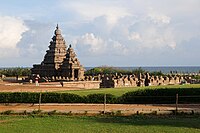 Shore Temple built by the Pallavas at Mamallapuram during the 8th century, now a UNESCO World Heritage Site
 Vettuvan Koil, the unfinished temple is believed to have been built during the 8th century by Pandyas in Kalugumalai, a panchayat town in Thoothukudi district.


Much later, the Pallavas were replaced by the Chola dynasty as the dominant kingdom in the 9th century and they in turn were replaced by the Pandyan Dynasty in the 13th century. The Pandyan capital Madurai was in the deep south away from the coast. They had extensive trade links with the south east Asian maritime empires of Srivijaya and their successors, as well as contacts, even formal diplomatic contacts, reaching as far as the Roman Empire. During the 13th century, Marco Polo mentioned the Pandyas as the richest empire in existence. Temples such as the Meenakshi Amman Temple at Madurai and Nellaiappar Temple at Tirunelveli are the best examples of Pandyan temple architecture.[40] The Pandyas excelled in both trade and literature. They controlled the pearl fisheries along the south coast of India, between Sri Lanka and India, which produced some of the finest pearls in the known ancient world.

Chola Empire

The Chola Empire at its greatest extent, during the reign of Rajendra Chola I in 1030


Architecture from Chola period From left to right: Airavatesvara Temple at Darasuram; Natarajan, Shiva as celestial dancer; and Parvathi, the consort of Shiva
- Great Living Chola Temples


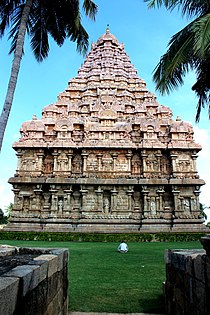 The pyramidal structure above the sanctum at Brihadisvara Temple
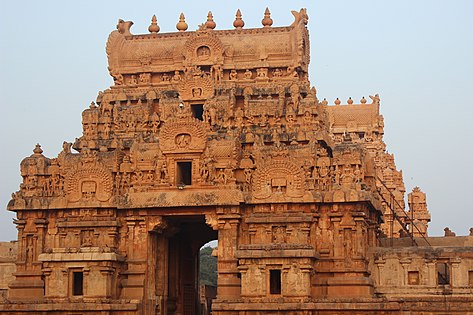 Brihadeeswara Temple Entrance Gopurams at Thanjavur


Vijayanagar and Nayak period (1336–1646)


Power struggles of the 18th century (1688–1802)
By the early 18th century, the political scene in Tamil Nadu saw a major change-over and was under the control of many minor rulers aspiring to be independent. The fall of the Vijayanagara empire and the Chandragiri Nayakas gave the sultanate of Golconda a chance to expand into the Tamil heartland. When the sultanate was incorporated into the Mughal Empire in 1688, the northern part of current-day Tamil Nadu was administrated by the nawab of the Carnatic, who had his seat in Arcot from 1715 onward. Meanwhile, to the south, the fall of the Thanjavur Nayaks led to a short-lived Thanjavur Maratha kingdom. The fall of the Madurai Nayaks brought up many small Nayakars of southern Tamil Nadu, who ruled small parcels of land called palayams. The chieftains of these Palayams were known as Palaiyakkarar (or 'polygar' as called by British) and were ruling under the nawabs of the Carnatic.
In the south, Nawabs granted taxation rights to the British which led to conflicts between British and the Palaiyakkarar, which resulted in series of wars called Polygar war to establish independent states by the aspiring Palaiyakkarar. Puli Thevar was one of the earliest opponents of the British rule in South India.[47] Thevar's prominent exploits were his confrontations with Marudhanayagam, who later rebelled against the British in the late 1750s and early 1760s. Rani Velu Nachiyar, was the first woman freedom fighter of India and Queen of Sivagangai.[48] She was drawn to war after her husband Muthu Vaduganatha Thevar (1750–1772), King of Sivaganga was murdered at Kalayar Kovil temple by British. Before her death, Queen Velu Nachi granted powers to the Maruthu brothers to rule Sivaganga.[49] Kattabomman (1760–1799), Palaiyakkara chief of Panchalakurichi who fought the British in the First Polygar War.[50] He was captured by the British at the end of the war and hanged near Kayattar in 1799. Veeran Sundaralingam (1700–1800) was the General of Kattabomman Nayakan's palayam, who died in the process of blowing up a British ammunition dump in 1799 which killed more than 150 British soldiers to save Kattapomman Palace. Oomaithurai, younger brother of Kattabomman, took asylum under the Maruthu brothers, Periya Marudhu and Chinna Marudhu and raised an army[51]. They formed a coalition with Dheeran Chinnamalai and Kerala Varma Pazhassi Raja which fought the British in Second Polygar Wars. Dheeran Chinnamalai (1756–1805), Polygar chieftain of Kongu and ally of Tipu Sultan who fought the British in the Second Polygar War. After winning the Polygar wars in 1801, the East India Company consolidated most of southern India into the Madras Presidency.
Princely state of Pudhukottai (1680–1948 CE)

British Colonial period (1801–1947 CE)
At the beginning of the 19th century, the British firmly established governance over entirety of Tamil Nadu. The Vellore mutiny on 10 July 1806 was the first instance of a large-scale mutiny by Indian sepoys against the British East India Company, predating the Indian Rebellion of 1857 by half a century.[53] The revolt, which took place in Vellore, was brief, lasting one full day, but brutal as mutineers broke into the Vellore fort and killed or wounded 200 British troops, before they were subdued by reinforcements from nearby Arcot.[54][55] The British crown took over the control governance from the Company and the remainder of the 19th century did not witness any native resistance until the beginning of 20th century Indian Independence movements. During the administration of Governor George Harris (1854–1859) measures were taken to improve education and increase representation of Indians in the administration. Legislative powers given to the Governor's council under the Indian Councils Act 1861 and 1909 Minto-Morley Reforms eventually led to the establishment of the Madras Legislative Council. Failure of the summer monsoons and administrative shortcomings of the Ryotwari system resulted in two severe famines in the Madras Presidency, the Great Famine of 1876–78 and the Indian famine of 1896–97. The famine led to migration of people as bonded labours for British to various countries which eventually formed the present Tamil diaspora.Post-Independence (1947–present)
When India became independent in 1947, Madras presidency became Madras state, comprising present-day Tamil Nadu, coastal Andhra Pradesh up to Ganjam district in Odisha, South Canara district Karnataka, and parts of Kerala. The state was subsequently split up along linguistic lines. In 1969, Madras State was renamed Tamil Nadu, meaning "Tamil country".[56]Geography

Topographic map of Tamil Nadu

Western Ghats traverse along the western border of Tamil Nadu
The western, southern and the north western parts are hilly and rich in vegetation. The Western Ghats and the Eastern Ghats meet at the Nilgiri hills. The Western Ghats traverse the entire western border with Kerala, effectively blocking much of the rain bearing clouds of the south west monsoon from entering the state. The eastern parts are fertile coastal plains and the northern parts are a mix of hills and plains. The central and the south central regions are arid plains and receive less rainfall than the other regions.
Tamil Nadu has the country's third longest coastline at about 906.9 km (563.5 mi).[57] Tamil Nadu's coastline bore the brunt of the 2004 Indian Ocean tsunami when it hit India, which caused 7,793 direct deaths in the state. Tamil Nadu falls mostly in a region of low seismic hazard with the exception of the western border areas that lie in a low to moderate hazard zone; as per the 2002 Bureau of Indian Standards (BIS) map, Tamil Nadu falls in zones II and III. Historically, parts of this region have experienced seismic activity in the M5.0 range.[58]
Climate
Tamil Nadu is mostly dependent on monsoon rains, and thereby is prone to droughts when the monsoons fail. The climate of the state ranges from dry sub-humid to semi-arid. The state has two distinct periods of rainfall:- south west monsoon from June to September, with strong southwest winds;
- North east monsoon from October to December, with dominant north east winds;
Flora and fauna
There are about 2,000 species of wildlife that are native to Tamil Nadu. Protected areas provide safe habitat for large mammals including elephants, tigers, leopards, wild dogs, sloth bears, gaurs, lion-tailed macaques, Nilgiri langurs, Nilgiri tahrs, grizzled giant squirrels and sambar deer, resident and migratory birds such as cormorants, darters, herons, egrets, open-billed storks, spoonbills and white ibises, little grebes, Indian moorhen, black-winged stilts, a few migratory ducks and occasionally grey pelicans, marine species such as the dugongs, turtles, dolphins, Balanoglossus and a wide variety of fish and insects.Indian Angiosperm diversity comprises 17,672 species with Tamil Nadu leading all states in the country, with 5640 species accounting for 1/3 of the total flora of India. This includes 1,559 species of medicinal plants, 533 endemic species, 260 species of wild relatives of cultivated plants and 230 red-listed species. The Gymnosperm diversity of the country is 64 species of which Tamil Nadu has four indigenous species and about 60 introduced species. The Pteridophytes diversity of India includes 1,022 species of which Tamil Nadu has about 184 species. Vast numbers of bryophytes, lichen, fungi, algae and bacteria are among the wild plant diversity of Tamil Nadu.
Common plant species include the state tree: palmyra palm, eucalyptus, rubber, cinchona, clumping bamboos (Bambusa arundinacea), common teak, Anogeissus latifolia, Indian laurel, grewia, and blooming trees like Indian labumusum, ardisia, and solanaceae. Rare and unique plant life includes Combretum ovalifolium, ebony (Diospyros nilagrica), Habenaria rariflora (orchid), Alsophila, Impatiens elegans, Ranunculus reniformis, and royal fern.[60]
National and state parks

Sathyamangalam Tiger Reserve has the largest elephant population in India.
Governance and administration

Chennai High Court, Chennai
Tamil Nadu had a bicameral legislature until 1986, when it was replaced with a unicameral legislature, like most other states in India. The term length of the government is five years. The present government is headed by Edappadi K. Palaniswami, after the demise of former Chief Minister of Tamil Nadu, J. Jayalalithaa of the All India Anna Dravida Munnetra Kazhagam. The Tamil Nadu legislative assembly is housed at the Fort St. George in Chennai. The state had come under the President's rule on four occasions – first from 1976 to 1977, next for a short period in 1980, then from 1988 to 1989 and the latest in 1991.
Tamil Nadu has been a pioneering state of E-Governance initiatives in India. A large part of the government records like land ownership records are digitised and all major offices of the state government like Urban Local Bodies – all the corporations and municipal office activities – revenue collection, land registration offices, and transport offices have been computerised. Tamil Nadu is one of the states where law and order has been maintained largely successfully.[66] The Tamil Nadu Police Force is over 140 years old. It is the fifth largest state police force in India (as of 2015, total police force of TN is 1,11,448) and has the highest proportion of women police personnel in the country (total women police personnel of TN is 13,842 which is about 12.42%) to specifically handled violence against women in Tamil Nadu.[67][68] In 2003, the state had a total police population ratio of 1:668, higher than the national average of 1:717.
Administrative subdivisions

Districts of Tamil Nadu
| District | Headquarters | Area | Population (2011) |
Population density | |
|---|---|---|---|---|---|
| 1 | Ariyalur | Ariyalur | 1,944 km2 | 752,481 | 387 /km2 |
| 2 | Chennai | Chennai | 174 km2 | 4,681,087 | 26,903 /km2 |
| 3 | Coimbatore | Coimbatore | 4,642 km2 | 3,172,578 | 648 /km2 |
| 4 | Cuddalore | Cuddalore | 3,705 km2 | 2,600,880 | 702 /km2 |
| 5 | Dharmapuri | Dharmapuri | 4,527 km2 | 1,502,900 | 332 /km2 |
| 6 | Dindigul | Dindigul | 6,054 km2 | 2,161,367 | 357 /km2 |
| 7 | Erode | Erode | 5,692 km2 | 2,259,608 | 397 /km2 |
| 8 | Kallakurichi | Kallakurichi | 2,174 km2 | 548,950 | 254 /km2 |
| 9 | Kanyakumari | Nagercoil | 1,685 km2 | 1,863,174 | 1,106 /km2 |
| 10 | Kanchipuram | Kanchipuram | 4,305 km2 | 2,690,897 | 666 /km2 |
| 11 | Karur | Karur | 2,902 km2 | 1,076,588 | 371 /km2 |
| 12 | Krishnagiri | Krishnagiri | 5,091 km2 | 1,883,731 | 370 /km2 |
| 13 | Madurai | Madurai | 3,695 km2 | 2,441,038 | 663 /km2 |
| 14 | Nagapattinam | Nagapattinam | 2,416 km2 | 1,614,069 | 668 /km2 |
| 15 | Namakkal | Namakkal | 3,402 km2 | 1,721,179 | 506 /km2 |
| 16 | Nilgiris | Udagamandalam | 2,552 km2 | 735,071 | 288 /km2 |
| 17 | Perambalur | Perambalur | 1,748 km2 | 564,511 | 323 /km2 |
| 18 | Pudukkottai | Pudukkottai | 4,652 km2 | 1,618,725 | 348 /km2 |
| 19 | Ramanathapuram | Ramanathapuram | 4,180 km2 | 1,337,560 | 320 /km2 |
| 20 | Salem | Salem | 5,249 km2 | 3,480,008 | 663 /km2 |
| 21 | Sivaganga | Sivaganga | 4,140 km2 | 1,341,250 | 324 /km2 |
| 22 | Thanjavur | Thanjavur | 3,477 km2 | 2,302,781 | 661 /km2 |
| 23 | Theni | Theni | 2,872 km2 | 1,143,684 | 397 /km2 |
| 24 | Thoothukudi | Thoothukudi | 4,599 km2 | 1,738,376 | 378 /km2 |
| 25 | Tiruchirappalli | Tiruchirappalli | 4,508 km2 | 2,713,858 | 602 /km2 |
| 26 | Tirunelveli | Tirunelveli | 6,709 km2 | 3,072,880 | 458 /km2 |
| 27 | Tirupur | Tirupur | 5,192 km2 | 2,471,222 | 476 /km2 |
| 28 | Tiruvallur | Tiruvallur | 3,552 km2 | 3,725,697 | 1,049 /km2 |
| 29 | Tiruvannamalai | Tiruvannamalai | 6,188 km2 | 4,121,965 | 667 /km2 |
| 30 | Tiruvarur | Tiruvarur | 2,379 km2 | 1,268,094 | 533 /km2 |
| 31 | Vellore | Vellore | 6,081 km2 | 4,028,106 | 671 /km2 |
| 32 | Viluppuram | Viluppuram | 5,080 km2 | 295,687 | 482 /km2 |
| 33 | Virudhunagar | Virudhunagar | 4,280 km2 | 1,943,309 | 454 /km2 |
| 34 | Tenkasi | Tenkasi | km2 | /km2 | |
| 35 | Chengalpattu | Chengalpattu | km2 | /km2 |
Politics

Fort St. George hosts the Chief Secretariat of the government of Tamil Nadu.
Pre-Independence
Prior to Indian independence Tamil Nadu was under British colonial rule as part of the Madras Presidency. The main party in Tamil Nadu at that time was the Indian National Congress (INC). Regional parties have dominated state politics since 1916. One of the earliest regional parties, the South Indian Welfare Association, a forerunner to Dravidian parties in Tamil Nadu, was started in 1916. The party was called after its English organ, Justice Party, by its opponents. Later, South Indian Liberal Federation was adopted as its official name. The reason for victory of the Justice Party in elections was the non-participation of the INC, demanding complete independence of India.The Justice Party which was under E.V.Ramaswamy was renamed Dravidar Kazhagam in 1944. It was a non-political party which demanded the establishment of an independent state called Dravida Nadu. However, due to the differences between its two leaders EVR and C.N. Annadurai, the party was split. Annadurai left the party to form the Dravida Munnetra Kazhagam (DMK). The DMK decided to enter politics in 1956.
Post-Independence
| Political Alliance |
Assembly (2016) |
Lok Sabha (2019) |
|---|---|---|
| AIADMK+ | 123 | 1 |
| DMK+ | 110 | 37 |
| Source: Election Commission of India.[75][76] | ||
Demographics
| Historical population | ||
|---|---|---|
| Year | Pop. | ±% |
| 1951 | 30,119,000 | — |
| 1961 | 33,687,000 | +11.8% |
| 1971 | 41,199,000 | +22.3% |
| 1981 | 48,408,000 | +17.5% |
| 1991 | 55,859,000 | +15.4% |
| 2001 | 62,406,000 | +11.7% |
| 2011 | 72,138,958 | +15.6% |
| Source:Census of India[77] | ||
At the 2011 India census, Tamil Nadu had a population of 72,147,030.[80] The sex ratio of the state is 995 with 36,137,975 males and 36,009,055 females. There are a total of 23,166,721 households.[80] The total children under the age of 6 is 7,423,832. A total of 14,438,445 people constituting 20.01 per cent of the total population belonged to Scheduled Castes (SC) and 794,697 people constituting 1.10 per cent of the population belonged to Scheduled tribes (ST).[81][80]
The state has 51,837,507 literates, making the literacy rate 80.33 per cent. There are a total of 27,878,282 workers, comprising 4,738,819 cultivators, 6,062,786 agricultural labourers, 1,261,059 in house hold industries, 11,695,119 other workers, 4,120,499 marginal workers, 377,220 marginal cultivators, 2,574,844 marginal agricultural labourers, 238,702 marginal workers in household industries and 929,733 other marginal workers.[82]
| Rank | Name | District | Pop. | ||||||
|---|---|---|---|---|---|---|---|---|---|
 Chennai  Coimbatore |
1 | Chennai | Chennai | 8,696,010 |  Madurai  Tiruchirappalli | ||||
| 2 | Coimbatore | Coimbatore | 2,151,466 | ||||||
| 3 | Madurai | Madurai | 1,462,420 | ||||||
| 4 | Tiruchirappalli | Tiruchirappalli | 1,021,717 | ||||||
| 5 | Tiruppur | Tiruppur | 962,982 | ||||||
| 6 | Salem | Salem | 919,150 | ||||||
| 7 | Erode | Erode | 521,776 | ||||||
| 8 | Tirunelveli | Tirunelveli | 498,984 | ||||||
| 9 | Vellore | Vellore | 481,966 | ||||||
| 10 | Thoothukudi | Thoothukudi | 410,760 | ||||||
Among the cities in 2011, the state capital Chennai, was the most populous city in the state, followed by Coimbatore, Madurai, Trichy and Salem respectively.[83] India has a human development index calculated as 0.619, while the corresponding figure for Tamil Nadu is 0.736, placing it among the top states in the country.[84][85] The life expectancy at birth for males is 65.2 years and for females it is 67.6 years.[86] However, it has a high level of poverty especially in the rural areas. In 2004–2005, the poverty line was set at ₹ 351.86/month for rural areas and ₹ 547.42/month for urban areas. Poverty in the state dropped from 51.7 per cent in 1983 to 21.1 per cent in 2001[87] For the period 2004–2005, the Trend in Incidence of Poverty in the state was 22.5 per cent compared with the national figure of 27.5 per cent. The World Bank is currently assisting the state in reducing poverty, High drop-out and low completion of secondary schools continue to hinder the quality of training in the population. Other problems include class, gender, inter-district and urban-rural disparities. Based on URP – Consumption for the period 2004–2005, percentage of the state's population Below Poverty Line was 27.5 per cent. The Oxford Poverty and Human Development Initiative ranks Tamil Nadu to have a Multidimensional Poverty Index of 0.141, which is in the level of Ghana among the developing countries.[88] Corruption is a major problem in the state with Transparency International ranking it the second most corrupt among the states of India.[89]
Religion
Language
Tamil is the sole official language of Tamil Nadu while English is declared an additional official language for communication purposes.[5] When India adopted national standards Tamil was the first language to be recognised as a classical language of India.[92] As of 2001 census Tamil is spoken as the first language by nearly 90 percent of the state's population followed by Telugu (5.65%), Kannada (1.67%), Urdu (1.51%), Malayalam (0.89%), Marathi (0.1%) and Saurashtra (0.1%).[5]Education
Tamil Nadu is one of the most literate states in India.[94] Tamil Nadu has performed reasonably well in terms of literacy growth during the decade 2001–2011. A survey conducted by the industry body Assocham ranks Tamil Nadu top among Indian states with about 100 per cent Gross Enrollment Ratio (GER) in primary and upper primary education. One of the basic limitations for improvement in education in the state is the rate of absence of teachers in public schools, which at 21.4 per cent is significant.[95] The analysis of primary school education in the state by Pratham shows a low drop-off rate but poor quality of state education compared to other states.[96] Tamil Nadu has 37 universities, 552 engineering colleges[97] 449 Polytechnic Colleges[98] and 566 arts and science colleges, 34,335 elementary schools, 5,167 high schools, 5,054 higher secondary schools and 5,000 hospitals. Some of the notable educational institutes present in Tamil Nadu are Indian Institute of Technology Madras, Madras Institute of Technology, College of Engineering, Guindy, Indian Institute of Management Tiruchirappalli, St. Joseph’s Institute of Management Tiruchirappalli, Jamal Mohamed CollegeTiruchirappalli, Indian Maritime University, National Institute of Technology, Tiruchirappalli, Tamil Nadu Dr. Ambedkar Law University, Madras Medical College, Madras Veterinary College, Stanley Medical College, Chennai, Loyola College, Chennai, Ethiraj College for Women, Stella Maris College, Chennai, Anna University, PSG College of Technology, Government College of Technology, Coimbatore, Bharathiar University, Coimbatore and Tamil Nadu Agricultural University, Coimbatore, Sri Ramachandra Medical College and Research Institute.Tamil Nadu now has 69 per cent reservation in educational institutions for socially backward section of the society, the highest among all Indian states.[99] The Midday Meal Scheme programme in Tamil Nadu was first initiated by Kamaraj, then it was expanded by M G Ramachandran in 1983.
Culture

A State flag for Tamil Nadu was unilaterally proposed by the Government of Tamil Nadu in 1970.[100]

Seventh century paintings in the Sittanavasal Cave, Pudukottai
Literature
Tamil written literature has existed for over 2,000 years.[106] The earliest period of Tamil literature, Sangam literature, is dated from ca. 300 BC – AD 300.[107][108] It is the oldest Indian literature amongst all others.[109] The earliest epigraphic records found on rock edicts and hero stones date from around the 3rd century BC.[110][111]Most early Tamil literary works are in verse form, with prose not becoming more common until later periods. The Sangam literature collection contains 2381 poems composed by 473 poets, some 102 of whom remain anonymous.[112] Sangam literature is primarily secular, dealing with everyday themes in a Tamilakam context.[113] The Sangam literature also deals with human relationship and emotions.[114] The available literature from this period was categorised and compiled in the 10th century into two categories based roughly on chronology. The categories are: Pathinenmaelkanakku (The Major Eighteen Anthology Series) comprising Eṭṭuttokai (The Eight Anthologies) and the Pattupattu (Ten Idylls) and Pathinenkilkanakku (The Minor Eighteen Anthology Series).
Much of Tamil grammar is extensively described in the oldest known grammar book for Tamil, the Tolkāppiyam. Modern Tamil writing is largely based on the 1000 B.C grammar Naṉṉūl which restated and clarified the rules of the Tolkāppiyam, with some modifications. Traditional Tamil grammar consists of five parts, namely eḻuttu, sol, poruḷ, yāppu, aṇi. Of these, the last two are mostly applied in poetry.[115] Notable example of Tamil poetry include the Tirukkural written by Tiruvalluvar before 2000 years.
In 1578, the Portuguese published a Tamil book in old Tamil script named 'Thambiraan Vanakkam', thus making Tamil the first Indian language to be printed and published.[116] Tamil Lexicon, published by the University of Madras, is the first among the dictionaries published in any Indian language.[117] During the Indian freedom struggle, many Tamil poets and writers sought to provoke national spirit, social equity and secularist thoughts among the common man, notably Subramanya Bharathy and Bharathidasan.
Festivals and traditions
 Pongal is an important festival in Tamil Nadu.
 Thiruvalluvar was a Tamil poet and philosopher.


Music

M. S. Subbulakshmi, was the first musician to be awarded the Bharat Ratna, India's highest civilian honour.
Film industry
Tamil Nadu is also home to the Tamil film industry nicknamed as "Kollywood", which released the most number of films in India in 2013.[127] The term Kollywood is a portmanteau of Kodambakkam and Hollywood.[128] Tamil cinema is one of the largest industries of film production in India.[129] In Tamil Nadu, cinema ticket prices are regulated by the government. Single screen theatres may charge a maximum of ₹50, while theaters with more than three screens may charge a maximum of ₹120 per ticket.[130] The first silent film in Tamil Keechaka Vadham, was made in 1916.[131] The first talkie was a multi-lingual film, Kalidas, which released on 31 October 1931, barely 7 months after India's first talking picture Alam Ara.[132] Swamikannu Vincent, who had built the first cinema of South India in Coimbatore, introduced the concept of "Tent Cinema" in which a tent was erected on a stretch of open land close to a town or village to screen the films. The first of its kind was established in Madras, called "Edison's Grand Cinemamegaphone". This was due to the fact that electric carbons were used for motion picture projectors.[133]Television industry
There are more than 30 television channels of various genre in Tamil. DD Podhigai, Doordarshan's Tamil language regional channel was launched on 14 April 1993.[134] The first private Tamil channel, Sun TV was founded in 1993 by Kalanidhi Maran. In Tamil Nadu, the television industry is influenced by politics and majority of the channels are owned by politicians or people with political links.[135] The government of Tamil Nadu distributed free televisions to families in 2006 at an estimated cost ₹3.6 billion (US$52 million) of which has led to high penetration of TV services.[136][137] Cable used to be the preferred mode of reaching homes controlled by government run operator Arasu Cable.[138] From the early 2010s, Direct to Home has become increasingly popular replacing cable television services.[139] Tamil television serials form a major prime time source of entertainment and are directed usually by one director unlike American television series, where often several directors and writers work together.[140]Cuisine

Vegetarian food from Tamil Nadu served in a banana leaf
Economy

TIDEL Park Coimbatore; Coimbatore is one of the leading IT/ITS centres in India.
| Year | GSDP | Growth Rate | Share in India |
|---|---|---|---|
| 2000–01 | 142,065 | 5.87% | 7.62% |
| 2001–02 | 139,842 | −1.56% | 7.09% |
| 2002–03 | 142,295 | 1.75% | 6.95% |
| 2003–04 | 150,815 | 5.99% | 6.79% |
| 2004–05 | 219,003 | 11.45% | 7.37% |
| 2005–06 | 249,567 | 13.96% | 7.67% |
| 2006–07 | 287,530 | 15.21% | 8.07% |
| 2007–08 | 305,157 | 6.13% | 7.83% |
| 2008–09 | 321,793 | 5.45% | 7.74% |
| 2009–10 | 356,632 | 10.83% | 7.89% |
| 2010–11 | 403,416 | 13.12% | 8.20% |
| 2011–12 | 433,238 | 7.39% | 8.26% |
| 2012–13 | 447,944 | 3.39% | 8.17% |
| 2013–14 | 480,618 | 7.29% | 8.37% |
Tamil Nadu has six Nationalised Home Banks which originated in this state; Two government-sector banks Indian Bank and Indian Overseas Bank in Chennai, and Four private-sector banks City Union Bank in Kumbakonam, Karur Vysya Bank, Lakshmi Vilas Bank in Karur, and Tamilnad Mercantile Bank Limited in Tuticorin.
Agriculture
Tamil Nadu has historically been an agricultural state and is a leading producer of agricultural products in India. In 2008, Tamil Nadu was India's fifth biggest producer of rice. The total cultivated area in the state was 5.60 million hectares in 2009–10.[149] The Cauvery delta region is known as the Rice Bowl of Tamil Nadu.[150][better source needed] In terms of production, Tamil Nadu accounts for 10 percent in fruits and 6 percent in vegetables, in India.[151] Annual food grains production in the year 2007–08 was 10035,000 mt.[149]
Tamil Nadu is the largest producer of turmeric.

Agriculture forms a major portion of the state's economy.
Textiles and leather

Kanchipuram hand loom silk sarees
Automobiles
Tamil Nadu has seen major investments in the automobile industry over many decades manufacturing cars, railway coaches, battle-tanks, tractors, motorcycles, automobile spare parts and accessories, tyres and heavy vehicles. Chennai is known as the Detroit of India.[165] Major global automobile companies including BMW, Ford, Robert Bosch, Renault-Nissan, Caterpillar, Hyundai, Mitsubishi Motors, and Michelin as well as Indian automobile majors like Mahindra & Mahindra, Ashok Leyland, Eicher Motors, Isuzu Motors, TI cycles, Hindustan Motors, TVS Motors, Irizar-TVS, Royal Enfield, MRF, Apollo Tyres, TAFE Tractors, Daimler AG Company invested (₹) 4 billion for establishing a new plant in Tamil Nadu.[166]Heavy industries and engineering
Tamil Nadu is one of the highly industrialised states in India. Over 11% of the S&P CNX 500 conglomerates have corporate offices in Tamil Nadu.[citation needed]The state government owns the Tamil Nadu Newsprint and Papers,[167] in Karur.
Coimbatore is also referred to as "the Pump City" as it supplies two-thirds of India's requirements of motors and pumps. The city is one of the largest exporters of wet grinders and auto components and the term "Coimbatore Wet Grinder" has been given a Geographical indication.[168]
Electronics and software
Electronics manufacturing is a growing industry in Tamil Nadu, with many international companies like Nokia, Flex, Motorola, Sony-Ericsson, Foxconn, Samsung, Cisco, Moser Baer, Lenovo, Dell, Sanmina-SCI, Bosch, Texas Instruments having chosen Chennai as their south Asian manufacturing hub. Products manufactured include circuit boards and cellular phone handsets.[169]Tamil Nadu is the second largest software exporter by value in India. Software exports from Tamil Nadu grew from ₹ 76 billion ($1.6 billion) in 2003–04 to ₹ 207 billion {$5 billion} by 2006–07 according to NASSCOM[170] and to ₹ 366 billion in 2008–09 which shows 29 per cent growth in software exports according to STPI. Major national and global IT Companies such as Atos Syntel, Infosys, Wipro, HCL Technologies, Tata Consultancy Services, Verizon, Hewlett-Packard Enterprise, Amazon.com, Capgemini, CGI, PayPal, IBM, NTT DATA, Accenture, Ramco Systems, Robert Bosch GmbH, DXC Technology, Cognizant, Tech Mahindra, Virtusa, LTI, Mphasis, Mindtree, Hexaware Technologies and many others have offices in Tamil Nadu. The top engineering colleges in Tamil Nadu have been a major recruiting hub for the IT firms. According to estimates, about 50 percent of the HR required for the IT and ITES industry was being sourced from the state.[171] Coimbatore is the second largest software producer in the state, next to Chennai.[172]
Infrastructure
Transport
Road

A view of the NH 544 Expressway between Coimbatore and Salem in Tamil Nadu

Pamban road (left) and rail (right) bridges, connecting the Indian mainland with the Pamban Island


Chennai International Airport, one of India's major international airports
Rail
Tamil Nadu has a well-developed rail network as part of Southern Railway. Headquartered at Chennai, the Southern Railway network extends over a large area of India's southern peninsula, covering the states of Tamil Nadu, Kerala, Puducherry, a small portion of Karnataka and a small portion of Andhra Pradesh. Express trains connect the state capital Chennai with Mumbai, Delhi and Kolkata. Puratchi Thalaivar Dr. M.G. Ramachandran Central Railway Station is gateway for trains towards the north whereas Chennai Egmore serves as the gateway for the south. Tamil Nadu has a total railway track length of 5,952 km (3,698 mi) and there are 532 railway stations in the state. The network connects the state with most major cities in India. The Nilgiri Mountain Railway (part of the Mountain Railways of India) is one of the UNESCO World Heritage Site connecting Ooty on the hills and Mettupalayam in the foot hills which is in turn connected to Coimbatore. The centenary old Pamban Bridge over sea connecting Rameswaram in Pamban island to mainland is an engineering marvel. It is one of the oldest cantilever bridges still in operation, the double-leaf bascule bridge section can be raised to let boats and small ships pass through Palk Strait in Indian Ocean. The Government of Tamil Nadu created a Special Purpose Vehicle (SPV) for implementing the Chennai Metro Rail Project. This SPV named as “Chennai Metro Rail Limited” was incorporated on 3 December 2007 under the Companies Act. It has now been converted into a Joint Venture of Government of India and Government of Tamil Nadu with equal equity holding. Chennai has a well-established suburban railway network and is constructing a Chennai Metro with phase1 operational since July 2015 . Major railway junctions( 4 and above lines ) in the state are Chennai, Coimbatore, Katpadi, Madurai, Salem, Erode, Dindigul, Karur, Nagercoil, Tiruchirapalli and Tirunelveli. Puratchi Thalaivar Dr. M.G. Ramachandran Central Railway Station, Madurai Junction, Katpadi Junction, Chennai Egmore, Salem Junction, Tiruchirappalli Junction, Coimbatore Junction are upgraded to A1 grade level. Loco sheds are located at Erode, Arakkonam, Royapuram in Chennai and Tondaiyarpet in Chennai, Ponmalai (GOC) in Tiruchirappalli as Diesel Loco Shed. The loco shed at Erode is a huge composite Electric and Diesel Loco shed. MRTS which covers from Chennai Beach to Velachery, and metro rail also running between Alandur and koyambedu station.Airports
Tamil Nadu has four international airports, namely Chennai International Airport, Coimbatore International Airport, Tiruchirapalli International Airport and Madurai International Airport. Salem Airport and Thoothukudi Airport are domestic airports. Chennai International Airport is a major international airport and aviation hub in South Asia. Besides civilian airports, the state has four air bases of the Indian Air Force namely Thanjavur AFS, Tambram AFS, Coimbatore AFS and two naval air stations INS Rajali and INS Parundu of Indian Navy.Seaport

V. O. Chidambaranar Port Trust in Thoothukudi, one of India's major seaports
Energy


Sports
Kabbadi, also known as Sadugudu, is recognised as the state game in Tamil Nadu.[187] The traditional sports of Tamil Nadu include Silambam,[188] a Tamil martial arts played with a long bamboo staff, cockfight, Jallikattu,[189] a bull taming sport famous on festival occasions, ox-wagon racing known as Rekkala,[190][188] kite flying also known as Pattam viduthal,[189] Goli, the game with marbles,[189] Aadu Puli, the "goat and tiger" game[189] and Kabaddi also known as Sadugudu.[189] Most of these traditional sports are associated with festivals of land like Thai Pongal and mostly played in rural areas.[189] S. Ilavazhagi carrom world champion from 2002–2016
The M. A. Chidambaram Stadium, Chennai

Viswanathan Anand, world chess champion 2007–2013
Tennis is also a popular sport in Tamil Nadu with notable international players including Ramesh Krishnan,[197] Ramanathan Krishnan,[197] Vijay Amritraj[198] and Mahesh Bhupathi. Nirupama Vaidyanathan, the first Indian women to play in a grand slam tournament also hails from the state. The ATP Chennai Open tournament is held in Chennai every January. The Sports Development Authority of Tamil Nadu (SDAT) owns Nungambakkam tennis stadium which hosts Chennai Open and Davis Cup play-off tournaments.
The Tamil Nadu Hockey Association is the governing body of hockey in the state. Vasudevan Baskaran was the captain of the Indian team that won gold medal in 1980 Olympics at Moscow. The Mayor Radhakrishnan Stadium in Chennai hosts international hockey events and is regarded by the International Hockey Federation as one of the best in the world for its infrastructure.[199]
Tamil Nadu also has golf ground in Coimbatore, The Coimbatore Golf Club is an 18-hole golf course located in Chettipalayam in Coimbatore, located within the city limits in the state of Tamil Nadu in India. The club is also a popular venue for major golf tournaments held in India.
The Sports Development Authority of Tamil Nadu (SDAT), a government body, is vested with the responsibility of developing sports and related infrastructure in the state.[200] The SDAT owns and operates world class stadiums and organises sporting events.[201] It also accommodates sporting events, both at domestic and international level, organised by other sports associations at its venues. The YMCA College of Physical Education at Nandanam in Chennai was established in 1920 and was the first college for physical education in Asia. The Jawaharlal Nehru Stadium in Chennai is a multi-purpose stadium hosting football and track and field events. The Indian Triathlon Federation and the Volleyball Federation of India are headquartered in Chennai. Chennai hosted India's first ever International Beach Volleyball Championship in 2008. The SDAT – TNSRA Squash Academy in Chennai is one of the very few academies in south Asia hosting international squash events.Jawaharlal Nehru Stadium in Coimbatore, it is a football stadium and also a multi-purpose stadium in Coimbatore constructed in 1971.
Tourism

See also
References
Citations
Sources
- "India sets up classical languages". BBC. 17 August 2004. Retrieved 16 August 2007.
- "Radhakrishnan Stadium to have new turf". The Hindu. Chennai, India. 20 October 2004. Retrieved 10 September 2012.
- "Tamil Nadu ranks third in FDI, favoured destination". The Hindu. Chennai, India. 22 April 2005. Retrieved 10 September 2012.
- "Chennai is the most densely populated city in Tamil Nadu, according to census 2011". The Hindu. Chennai, India. 2 June 2013. Retrieved 20 April 2014.
- "Skeletons dating back 3,800 years throw light on evolution". The Times of India. 1 January 2006. Retrieved 11 June 2008.
- "The Hindu: National: Skeletons, script found at ancient burial site in Tamil Nadu". The Hindu. Chennai, India. 26 May 2004. Retrieved 11 June 2008.
- "The Hindu: National: 'Rudimentary Tamil-Brahmi script' unearthed at Adichanallur". The Hindu. 17 December 2005. Archived from the original on 28 January 2007. Retrieved 11 June 2008.
- Staff Reporter (22 November 2005). "Students get glimpse of heritage". The Hindu. Chennai, India. Retrieved 26 April 2007.
- Radha Venkatesan (1 October 2009). "India's Jurassic nest dug up in Tamil Nadu". The Times of India. Retrieved 2 October 2009.
- "New DGP takes charge". The Times of India. Retrieved 20 May 2012.
- "Tamil Nadu India's most literate state: HRD ministry". The Times of India. 14 May 2003. Retrieved 18 July 2010.
- Bunting, Madeleine (15 March 2011). "Quality of Primary Education in States". The Guardian. London. Retrieved 20 May 2012.
- "Top three States – a socio-economic comparison". The Hindu Business Line. 20 October 2004. Retrieved 10 September 2012.
- "Tamil Nadu Poverty". The Hindu Business Line. 9 April 2004. Retrieved 10 September 2012.
- "Tamil Nadu Hunger Problem Alarming". BBC News. 14 October 2008. Retrieved 10 September 2012.
- "Tamil Nadu Hunger Level in Danger List". The Times of India. 15 October 2008. Retrieved 10 September 2012.
- "Oscars: Eight on ten for 'Slumdog Millionaire'". The Times of India. 23 February 2009. Retrieved 23 September 2009.
- "Indian joy at Oscar night glory". BBC News. 23 February 2009. Retrieved 23 September 2009.
- "A R Rahman wins best original score Oscar". Economic Times. 23 February 2009. Retrieved 23 September 2009.
- "Bihar is country's fastest growing state at 13.1%". The Times of India. 2 June 2012.
- Mungekar, Bhalchandra (12 June 2012). "Contrary to Modi's projections, Gujarat's growth story is riddled with contradictions – The Economic Times". The Times of India.
- "Flextronics signs pact for Chennai facility". The Hindu Business Line. 7 October 2005. Archived from the original on 2 September 2010. Retrieved 10 September 2012.
- "TN software exports clock 32 pc growth". The Hindu Business Line. 7 May 2006. Archived from the original on 8 October 2009. Retrieved 10 September 2012.
- "TN makes its way to top 5 states in HDI". 24 March 2008. Retrieved 24 March 2008.
- "Tamil Nadu the most urbanised State: Minister". The Hindu. Chennai, India. 18 May 2008. Retrieved 10 September 2012.
- "Education is the means of social mobility – Rediff India Abroad". Rediff. 1 May 2006. Retrieved 10 September 2012.
- "Permit cock fight: Bench". The Hindu. Chennai, India. 14 January 2011. Retrieved 10 September 2012.
- "MA Chidambaram Stadium". Espncricinfo. 2012. Retrieved 8 June 2012.
- "Srinivas Venkataraghavan". Espncricinfo. 2012. Retrieved 8 June 2012.
- "Kris Srikkanth". Espncricinfo. 2012. Retrieved 8 June 2012.
- "Lakshmipathy Balaji". Espncricinfo. 2012. Retrieved 8 June 2012.
- "Ravichandran Ashwin". Espncricinfo. 2012. Retrieved 8 June 2012.
- "Ravichandran Ashwin". Espncricinfo. 2012. Retrieved 8 June 2012.
- "Laxman Sivaramakrishnan". Espncricinfo. 2012. Retrieved 8 June 2012.
- "Primary census abstract 2001". Directorate of Census Operations – Tamil Nadu. 2001. Archived from the original on 17 February 2011. Retrieved 8 June 2012.
- "Census of India". Census of India 2001. Government of India. 27 May 2002. Retrieved 14 April 2007.
- "State Domestic Product and other aggregates, 2004–05 series". Ministry of Statistics and Programme Implementation. 27 February 2015. Archived from the original on 23 March 2015. Retrieved 18 June 2015.
- "Gross State Domestic Product at Constant 2004–05 Prices (in Rs. Crore) and Growth (% YoY)" (PDF). Planning Commission of India. 2004. Retrieved 2 February 2015.
- "Tamil Nadu Legislative Assembly history". Assembly.tn.gov.in. 2012. Archived from the original on 13 April 2010. Retrieved 10 September 2012.
- "HDI and GDI Estimates for India and the States/UTs: Results and Analysis" (PDF). 16th if Union Territories are included. GDIGE. Archived from the original (PDF) on 16 March 2012. Retrieved 4 July 2012.
- "Human Development Index of India & Major States, 1981 – 2001" (PDF). Union Ministry of Social Justice. 2001. Archived from the original (PDF) on 22 July 2013. Retrieved 4 July 2012.
- "Sixth Economic Census". Ministry of Statistics and Programme Implementation, Gov of India. 2012. Archived from the original on 13 November 2012. Retrieved 10 September 2012.
- "Press Information Bureau English Releases". Pib.nic.in. 2012. Retrieved 10 September 2012.
- "UNESCO World Heritage List". Whc.unesco.org. Retrieved 10 September 2012.
- "Amateur Seismic Centre, Pune". Asc-india.org. 30 March 2007. Retrieved 10 September 2012.
- "Biodiversity, Tamil Nadu Dept. of Forests". Forests.tn.nic.in. 2012. Archived from the original on 6 February 2012. Retrieved 10 September 2012.
- "United Nations, System of Organisations". Unsystem.org. 2012. Archived from the original on 2 May 2012. Retrieved 10 September 2012.
- "List of Municipalities in Tamil Nadu". Comm. of Municipal Admin., Govt. of Tamil Nadu. 2011. Retrieved 7 September 2011.
- "Elections to Local Bodies" (PDF). Tamil State Election Commission. 2011. Archived from the original (PDF) on 26 October 2011. Retrieved 28 October 2011.
- "Districts of Tamil Nadu". Government of Tamil Nadu. 2011. Retrieved 6 November 2011.
- "Tamil Nadu Police". The Tamil Nadu Police. Retrieved 4 July 2012.
- "Tamil Nadu Police". The Tamil Nadu Police. Retrieved 4 July 2012.
- "Statistical Report of 2006 Tamil Nadu assembly results" (PDF). Election Commission of India. 2011.
- "List of Successful candidates" (PDF). Election Commission of India. 2009. Retrieved 4 July 2012.
- "Census Population" (PDF). Census of India. Ministry of Finance India. 2008. Retrieved 18 December 2008.
- "Distribution by Language – States and Union Territories – 2001". Censusindia.gov.in. Retrieved 10 September 2012.
- "Population by religious community". Censusindia.gov.in. Retrieved 10 September 2015.
- "Data Highlights: The Scheduled Tribes" (PDF). 2002. Retrieved 20 May 2012.
- "Teachers Absence from Public Schools in India – World Bank" (PDF). 2008. Retrieved 4 November 2010.
- "District wise Polytechnic colleges in Tamil Nadu during the year 2010–2011" (PDF). Directorate of Technical Education, Tamil Nadu. 2011. Archived from the original (PDF) on 13 October 2011. Retrieved 1 October 2011.
- "Glaring regional disparities in human development index". The Hindu. Chennai, India. 4 July 2008. Retrieved 10 September 2012.
- "Human Development Reports". Hdrstats.undp.org. 2010. Archived from the original on 24 October 2012. Retrieved 10 September 2012.
- "Multidimensional Poverty Index of Tamil Nadu". Southasia.oneworld.net. 28 July 2010. Retrieved 20 May 2012.
- "Beware the political superbug: Hubris!". Rediff.com. 17 May 2011. Retrieved 20 May 2012.
- "Cbfc India Annual Report 2011" (PDF). cbfcindia.gov.in. 2011. Archived from the original (PDF) on 24 January 2013. Retrieved 4 July 2012.
- "Most Enterprises in India". Indcom.tn.gov.in. 2011. Retrieved 10 September 2012.
- "Tamil Nadu – States and Union Territories – Know India: National Portal of India" (PDF). India.gov.in. 31 March 2009. Retrieved 4 November 2010.
- "National Horticulture Mission -Action Plan for Tamil Nadu" (PDF). 2008. Archived from the original (PDF) on 27 February 2012. Retrieved 10 September 2012.
- "Rubber Statistical News" (PDF). 2006. Archived from the original (PDF) on 17 July 2012. Retrieved 10 September 2012.
- "Production of Tea in India During And Up to August 2002". Teauction.com. 2002. Retrieved 10 September 2012.
- "Oil Palm Sector in India – World Wildlife Fund – India" (PDF). 2004. Retrieved 10 September 2012.
- "M. S. Swaminathan Research Foundation". Mssrf.org. 2010. Archived from the original on 10 September 2012. Retrieved 10 September 2012.
- "Livestock & Poultry Statistics from Ministry of Agriculture, Department of Animal Husbandry Dairying & Fisheries, Government of India". Dahd.nic.in. 2005. Archived from the original on 2 April 2012. Retrieved 10 September 2012.
- "Estimates of Egg Production". Dahd.nic.in. 2004. Archived from the original on 2 April 2012. Retrieved 10 September 2012.
- Tewari, Meenu (2000). "The Challenge of Reform: How Tamil Nadu's Textile and Apparel Industry is Facing the Pressures of Liberalisation" (PDF). The Government of Tamil Nadu, India and the Centre for International Development, Harvard University, Cambridge MA. Retrieved 4 July 2012.
- "Daimler Trucks Unveils Truck Test Track in Oragadam". Chennai: Daimler Chrysler. 2012. Archived from the original on 5 March 2012. Retrieved 4 July 2012.
- "What's new | India Yamaha Motor Pvt. Ltd". Yamaha-motor-india.com. 2012. Archived from the original on 29 August 2012. Retrieved 10 September 2012.
- "TNPL". TNPL. 2012. Retrieved 10 September 2012.
- "National Highways in Tamil Nadu". Ministry of Road Transport and Highways, Govt. of India. 2012. Retrieved 24 January 2012.
- "Official site for Tamil Nadu Highways". Tnhighways.org. 2012. Retrieved 10 September 2012.
- "Official website for Ennore Port". Ennoreport.gov.in. 2011. Retrieved 10 September 2012.
- "NPCIL". NPCIL. 2009. Archived from the original on 14 May 2009. Retrieved 23 September 2009.
- "Central Electricity Authority, GOI" (PDF). 2012. Archived from the original (PDF) on 10 May 2012. Retrieved 20 May 2012.
- "Youth Welfare & Sports Development Department". Tn.gov.in. 1992. Retrieved 4 November 2010.
- "Sports development authority of Tamil Nadu, Chennai 600 084". Sdat.in. 2012. Archived from the original on 21 April 2012. Retrieved 10 September 2012.
- "Tourism Statistics of India" (PDF). 2010. Archived from the original (PDF) on 31 January 2012. Retrieved 20 May 2012.
- "Great Living Chola Temples – UNESCO World Heritage Centre". Whc.unesco.org. 28 March 2012. Retrieved 10 September 2012.
- "Group of Monuments at Mahabalipuram". Whc.unesco.org. 2012. Retrieved 10 September 2012.
- "Tamil Nadu energy policy". Energy Department, Tamil Nadu, India by Govt. of Tamil Nadu. 2009.
- Croker, Bithia Mary (1907). The company's servant: a romance of southern India, Volume 1. London: Hurst and Blackett, Limited.
- Dil, Anwar S. (1980). Language and Linguistic Area: Essays by Murray Barnson Emeneau. Stanford University Press: Stanford, California – Reprinted (1980).
- Crego, Robert (2003). Sports and Games of the 18th and 19th Centuries. USA: Greewood Press. ISBN 978-0-313-31610-4.
- Garg, Chitra (2010). Indian Champions: Profiles Of Famous Indian Sportspersons. Delhi: Rajpal and Sons. ISBN 978-0-313-31610-4.
- Nobrega, William; Ashish Sinha (2008). Riding the Indian tiger: understanding India—the world's fastest growing market. John Wiley and Sons. p. 20.
- Li, Ming; Eric W. MacIntosh; Gonzalo A. Bravo (2012). International Sport Management. Ming Li, Eric W. MacIntosh, Gonzalo A. Bravo. ISBN 978-0-7360-8273-0.
- Ramaswamy, Vijaya (2007). Historical dictionary of the Tamils. United States: Scarecrow Press, INC. ISBN 978-0-470-82958-5{{inconsistent citations}}.
- Sastri, K. A. Nilakanta (2008). A History of South India (4th ed.). New Delhi, India: Oxford University Press.
- Sastri, K.A.Nilakanta (1970). Advanced History of India. New Delhi: Allied Publishers Pvt. Ltd. pp. 181–182.
- Sastri, K. A. Nilakanta (1935) [1935]. The Cōlas. Madras: University of Madras.
- Chopra, P.N.; Ravindran, T.K.; Subrahmanian, N (2003) [2003]. History of South India (Ancient, Medieval and Modern) Part 1. New Delhi: Chand Publications. ISBN 978-81-219-0153-6.
- Keay, John (2000) [2000]. India: A History. New York: Grove Publications. ISBN 978-0-8021-3797-5.
- Sastri, K.A. Nilakanta (2002) [1955]. A history of South India from prehistoric times to the fall of Vijayanagar. New Delhi: Indian Branch, Oxford University Press. ISBN 978-0-19-560686-7.
- Steever, Sanford (1998), "Introduction", in Steever, Sanford (ed.), The Dravidian Languages, London: Routledge, pp. 1–39, ISBN 978-0-415-10023-6
External links
Tamil Naduat Wikipedia's sister projects
 Definitions from Wiktionary
 Media from Wikimedia Commons
 News from Wikinews
 Quotations from Wikiquote
 Texts from Wikisource
 Textbooks from Wikibooks
 Travel guide from Wikivoyage
 Resources from Wikiversity
- Government
- General information
- Tamil Nadu Encyclopædia Britannica entry
- Tamil Nadu at Curlie
 Geographic data related to Tamil Nadu at OpenStreetMap


Keine Kommentare:
Kommentar veröffentlichen