Kerala
From Wikipedia, the free encyclopedia
Jump to navigation
Jump to search
Kerala
|
|---|
|
|
|
|
|
|
| Nickname(s):
|

Location of Kerala
|
Coordinates (Thiruvananthapuram):  8.5°N 77°ECoordinates: 8.5°N 77°E |
| Country |  India |
|---|
| Statehood | 1956 November 1; 62 years ago |
|---|
| Capital | Thiruvananthapuram |
|---|
| Districts | 14 |
|---|
| Government |
|---|
| • Body | Government of Kerala |
|---|
| • Governor | P. Sathasivam[1] |
|---|
| • Chief Minister | Pinarayi Vijayan (CPI (M)) |
|---|
| • Legislature | Unicameral (141 seats) |
|---|
| • Parliamentary constituencies | Rajya Sabha 9
Lok Sabha 20 |
|---|
| • High Court | Kerala High Court Kochi |
|---|
| Area |
|---|
| • Total | 38,863 km2 (15,005 sq mi) |
|---|
| Area rank | 22nd |
|---|
| Highest elevation | 2,695 m (8,842 ft) |
|---|
| Lowest elevation | −2.2 m (−7.2 ft) |
|---|
| Population
|
|---|
| • Total | 33,387,677 |
|---|
| • Rank | 13th |
|---|
| • Density | 860/km2 (2,200/sq mi) |
|---|
| Demonym(s) | Keralite, Malayali |
|---|
| GDP (2017–18)
|
|---|
| • Total | ₹6.86 trillion (US$99 billion) |
|---|
| • Per capita | ₹179,523 (US$2,600) |
|---|
| Languages |
|---|
| • Official | Malayalam[5] |
|---|
| • Additional official | English[6] |
|---|
| Time zone | UTC+05:30 (IST) |
|---|
| ISO 3166 code | IN-KL |
|---|
| Vehicle registration | KL |
|---|
| HDI (2018) |  0.784[7] (High) · 1st |
|---|
| Literacy (2011) | 94%[8] |
|---|
| Sex ratio (2011) | 1084 ♀/1000 ♂[8] |
|---|
| Website | kerala.gov.in |
|---|
|
| Symbols |
| Emblem |  Seal of Kerala |
|---|
| Animal |
Indian Elephant |
|---|
| Bird |
Great hornbill |
|---|
| Fish |
Green chromide |
|---|
| Insect |
Papilio buddha[9] |
|---|
| Flower |
Kanikonna |
|---|
| Fruit |
Jackfruit [10] |
|---|
| Tree |
Coconut tree[11] |
|---|
Kerala (
) is a state on the southwestern
Malabar Coast of
India. It was formed on 1 November 1956, following passage of the
States Reorganisation Act, by combining
Malayalam-speaking regions. Spread over 38,863 km
2 (15,005 sq mi), Kerala is the twenty-second
largest Indian state by area. It is bordered by
Karnataka to the north and northeast,
Tamil Nadu to the east and south, and the
Lakshadweep Sea[12] to the west. With 33,387,677 inhabitants as per the
2011 Census, Kerala is the
thirteenth-largest Indian state by population. It is divided into 14
districts with the capital being
Thiruvananthapuram.
Malayalam is the most widely spoken language and is also the official language of the state.
[13]
The
Chera Dynasty was the first prominent kingdom based in Kerala. The
Ay kingdom in the deep south and the
Ezhimala kingdom in the north formed the other kingdoms in the early years of the
Common Era
(CE or AD). The region had been a prominent spice exporter since
3000 BCE. The region's prominence in trade was noted in the works of
Pliny as well as the
Periplus around 100 CE. In the 15th century, the
spice trade attracted
Portuguese traders to Kerala, and paved the way for
European colonisation of India. At the time of
Indian independence movement in the early 20th century, there were two major
princely states in Kerala-
Travancore State and the
Kingdom of Cochin. They united to form the state of
Thiru-Kochi in 1949. The Malabar region, in the northern part of Kerala, had been a part of the
Madras province of
British India, which later became a part of the
Madras State post-independence. After the
States Reorganisation Act, 1956, the modern-day state of Kerala was formed by merging the
Malabar district of
Madras State (excluding
Gudalur taluk of
Nilgiris district,
Topslip, the
Attappadi Forest east of Anakatti), the state of Thiru-Kochi (excluding four southern taluks of
Kanyakumari district, Shenkottai and Tenkasi taluks), and the taluk of
Kasaragod (now
Kasaragod District) in
South Canara (
Tulunad) which was a part of Madras State.
The
economy of Kerala is the
12th-largest state economy in India with
₹6.86 trillion (US$99 billion) in
gross domestic product and a per capita GDP of
₹179,000 (US$2,600).
[3][4] Kerala has the lowest positive population growth rate in
India, 3.44%; the highest
Human Development Index
(HDI), 0.712 in 2015; the highest literacy rate, 93.91% in the 2011
census; the highest life expectancy, 77 years; and the highest sex
ratio, 1,084 women per 1,000 men. The state has witnessed significant
emigration, especially to
Arab states of the Persian Gulf during the
Gulf Boom of the 1970s and early 1980s, and its economy depends significantly on
remittances from a large
Malayali expatriate community.
Hinduism is practised by more than half of the population, followed by
Islam and
Christianity. The culture is a synthesis of
Aryan,
Dravidian,
Arab, and
European cultures,
[14] developed over millennia, under influences from other parts of India and abroad.
The production of
pepper and
natural rubber contributes significantly to the total national output. In the agricultural sector,
coconut,
tea,
coffee,
cashew
and spices are important. The state's coastline extends for 595
kilometres (370 mi), and around 1.1 million people in the state are
dependent on the fishery industry which contributes 3% to the state's
income. The state has the
highest media exposure in India with newspapers publishing in nine languages, mainly English and Malayalam. Kerala is one of the prominent
tourist destinations of India, with
backwaters, hill stations, beaches,
Ayurvedic tourism and
tropical greenery as its major attractions.
Etymology
The name Kerala has an uncertain etymology. One popular theory derives
Kerala from Malayali
kera 'coconut tree' and
alam 'land'; thus, 'land of coconuts',
[15] which is a nickname for the state used by locals due to the abundance of coconut trees.
[16] The word
Kerala is first recorded as
Keralaputra in a 3rd-century BCE rock inscription left by the
Maurya emperor Ashoka (274–237 BCE), one of
his edicts pertaining to welfare.
[17] The inscription refers to the local ruler as
Keralaputra (Sanskrit for 'son of Kerala' or 'son of Chera[s]'). This contradicts the theory that
kera is from 'coconut tree'.
[18] At that time, one of three states in the region was called
Cheralam in Classical Tamil:
Chera and
Kera are variants of the same word.
[19] The word
Cheral refers to the oldest known dynasty of Kerala kings and is derived from the Proto-Tamil-Malayalam word for 'lake'.
[20]
The earliest Sanskrit text to mention Kerala is the
Aitareya Aranyaka of the
Rigveda. Kerala is also mentioned in the
Ramayana and the
Mahabharata, the two Hindu epics.
[21] The
Skanda Purana mentions the ecclesiastical office of the
Thachudaya Kaimal who is referred to as
Manikkam Keralar, synonymous with the deity of the
Koodalmanikyam temple.
[22][23] Keralam may stem from the Classical
Tamil cherive-alam 'declivity of a hill or a mountain slope'
[24] or
chera alam 'land of the Cheras'. The
Greco-Roman trade map
Periplus Maris Erythraei refers to Keralaputra as
Celobotra.
[25]
History
Mythology
According to the
Tamil classic
Purananuru, the
Chera king
Senkuttuvan conquered the lands between
Kanyakumari and the
Himalayas.
[26] Lacking worthy enemies, he besieged the sea by throwing his spear into it.
[26][27] According to the 17th century
Malayalam work
Keralolpathi, the lands of Kerala were recovered from the sea by the axe-wielding warrior sage
Parasurama, the sixth
avatar of
Vishnu (hence, Kerala is also called
Parasurama Kshetram 'The Land of Parasurama'
[28]).
Parasurama threw his axe across the sea, and the water receded as far
as it reached. According to legend, this new area of land extended from
Gokarna to
Kanyakumari.
[29] The land which rose from sea was filled with salt and unsuitable for habitation; so Parasurama invoked the Snake King
Vasuki,
who spat holy poison and converted the soil into fertile lush green
land. Out of respect, Vasuki and all snakes were appointed as protectors
and guardians of the land.
P. T. Srinivasa Iyengar theorised, that
Senguttuvan may have been inspired by the
Parasurama legend, which was brought by early Aryan settlers.
[30]
Another much earlier
Puranic character associated with Kerala is
Mahabali, an
Asura and a prototypical just king, who ruled the earth from Kerala. He won the war against the
Devas, driving them into exile. The Devas pleaded before Lord
Vishnu, who took his fifth incarnation as
Vamana and pushed Mahabali down to
netherworld to placate the Devas. There is a belief that, once a year during the
Onam festival, Mahabali returns to Kerala.
[31] The
Matsya Purana, among the oldest of the 18
Puranas,
[32][33] uses the
Malaya Mountains of Kerala (and
Tamil Nadu) as the setting for the story of
Matsya, the first
incarnation of Vishnu, and
Manu, the first man and the king of the region.
[34][35]
Pre-history
A substantial portion of Kerala may have been under the sea in ancient times. Marine fossils have been found in an area near
Changanacherry, thus supporting the hypothesis.
[36] Pre-historical archaeological findings include
dolmens of the
Neolithic era in the
Marayur area of the Idukki district. They are locally known as "muniyara", derived from
muni (
hermit or
sage) and
ara (dolmen).
[37] Rock engravings in the
Edakkal Caves, in
Wayanad date back to the Neolithic era around 6000 BCE.
[38][39] Archaeological studies have identified
Mesolithic, Neolithic and
Megalithic sites in Kerala.
[40] The studies point to the development of ancient Kerala society and its culture beginning from the
Paleolithic Age, through the Mesolithic, Neolithic and Megalithic Ages.
[41] Foreign cultural contacts have assisted this cultural formation;
[42] historians suggest a possible relationship with
Indus Valley Civilization during the late
Bronze Age and early
Iron Age.
[43]
Ancient period
Kerala has been a major spice exporter since 3000 BCE, according to
Sumerian records and it is still referred to as the "Garden of Spices" or as the "Spice Garden of India".
[44][45]:79 Kerala's spices attracted ancient
Babylonians,
Assyrians and
Egyptians to the Malabar Coast in the 3rd and 2nd millennia BCE.
Phoenicians established trade with Kerala during this period.
[46] The
Land of Keralaputra was one of the four independent kingdoms in southern India during Ashoka's time, the others being
Chola,
Pandya, and
Satiyaputra.
[47] Scholars hold that Keralaputra is an alternate name of the
Cheras, the first dominant dynasty based in Kerala.
[48][49] These territories once shared a common language and culture, within an area known as
Tamilakam.
[50] Along with the
Ay kingdom in the south and the
Ezhimala kingdom in the north, the
Cheras formed the ruling kingdoms of Kerala in the early years of the Common Era (CE). It is noted in Sangam literature that the Chera king
Uthiyan Cheralathan ruled most of modern Kerala from his capital in
Kuttanad,
[52][53] and controlled the port of
Muziris, but its southern tip was in the kingdom of
Pandyas, which had a trading port sometimes identified in ancient Western sources as
Nelcynda (or
Neacyndi) in
Quilon.
[55] The lesser known
Ays and
Mushikas kingdoms lay to the south and north of the Chera regions respectively.
[56][57]
In the last centuries BCE the coast became important to the Greeks and Romans for its spices, especially
black pepper. The Cheras had trading links with
China,
West Asia,
Egypt,
Greece, and the
Roman Empire.
[58] In foreign-trade circles the region was known as
Male or
Malabar.
[59] Muziris, Berkarai, and Nelcynda were among the principal ports at that time.
[60] The value of Rome's annual trade with the region was estimated at around 50,000,000
sesterces;
[61] contemporary
Sangam literature
describes Roman ships coming to Muziris in Kerala, laden with gold to
exchange for pepper. One of the earliest western traders to use the
monsoon winds to reach Kerala was
Eudoxus of Cyzicus, around 118 or 166 BCE, under the patronage of
Ptolemy VIII, king of the
Hellenistic Ptolemaic dynasty in Egypt. Roman establishments in the port cities of the region, such as a temple of
Augustus and barracks for garrisoned Roman soldiers, are marked in the
Tabula Peutingeriana, the only surviving map of the Roman
cursus publicus.
[62][63]
Merchants from West Asia and Southern Europe established coastal posts and settlements in Kerala.
[64] The Israeli (Jewish) connection with Kerala started in 573 BCE.
[65][66][67] Arabs also had trade links with Kerala, starting before the 4th century BCE, as
Herodotus (484–413 BCE) noted that goods brought by Arabs from Kerala were sold to the Israelis [Hebrew (Jews)] at Eden.
[60] In the 4th century, some Christians also migrated from
Persia and joined the early
Syriac Christian community who trace their origins to the evangelistic activity of
Thomas the Apostle in the 1st century.
[68][69] Mappila was an honorific title that had been assigned to respected visitors from abroad; Israelite (Jewish), Syrian Christian, and
Muslim immigration account for later names of the respective communities:
Juda Mappilas,
Nasrani Mappilas and
Muslim Mappilas.
[70][71] The earliest
Saint Thomas Christian Churches,
[72] Cheraman Jumu'ah Masjid (traditionally dated to "629 CE" by the Mappilas)—regarded as "the first mosque of India"
[73]—and
Paradesi Synagogue (1568 CE)—the oldest active synagogue in the
Commonwealth of Nations[74]—were built in Kerala.
[75]
Early medieval period
A
second Chera Kingdom (c. 800–1102), also known as
Kulasekhara dynasty of Mahodayapuram (present-day
Kodungallur), was established by
Kulasekhara Varman,
which ruled over a territory comprising the whole of modern Kerala and a
smaller part of modern Tamil Nadu. During the early part of the
Kulasekara period, the southern region from
Nagercoil to
Thiruvalla was ruled by
Ay kings, who lost their power in the 10th century, making the region a part of the Kulasekara empire.
[76][77] Under Kulasekhara rule, Kerala witnessed a developing period of art, literature, trade and the
Bhakti movement of Hinduism.
[78] A
Keralite identity, distinct from the
Tamils, became linguistically separate during this period around the seventh century.
[79] For local administration, the empire was divided into provinces under the rule of
Naduvazhis, with each province comprising a number of
Desams under the control of chieftains, called as
Desavazhis.
[78]
The inhibitions, caused by a series of Chera-Chola wars in the
11th century, resulted in the decline of foreign trade in Kerala ports.
In addition, Portuguese invasions in the 15th century caused two major
religions,
Buddhism and
Jainism, to disappear from the land. It is known that the Menons in the Malabar region of Kerala were originally strong believers of
Jainism.
[80] The social system became fractured with divisions on
caste lines.
[81] Finally, the Kulasekhara dynasty was subjugated in 1102 by the combined attack of
Later Pandyas and
Later Cholas.
[76] However, in the 14th century, Ravi Varma Kulashekhara (1299–1314) of the southern
Venad kingdom
was able to establish a short-lived supremacy over southern India.
After his death, in the absence of a strong central power, the state was
divided into thirty small warring principalities; the most powerful of
them were the kingdom of
Samuthiri in the north, Venad in the south and
Kochi in the middle. In the 18th Century, Travancore King Sree
Anizham Thirunal Marthanda Varma
annexed all the kingdoms up to Northern Kerala through military
conquests, resulting in the rise of Travancore to pre-eminence in
Kerala. The Kochi ruler sued for peace with Anizham Thirunal and Malabar
came under direct
British rule until
India became independent.
[82][83]
Colonial era
The maritime
spice trade monopoly in the
Indian Ocean (Indu Maha Samundr) stayed with the Arabs during the
High and
Late Middle Ages. However, the dominance of Middle East traders was challenged in the European
Age of Discovery. After
Vasco Da Gama's arrival in
Kappad Kozhikode in 1498, the
Portuguese began to dominate eastern shipping, and the spice-trade in particular.
[84][85][86] The
Zamorin
of Kozhikode permitted the new visitors to trade with his subjects such
that Portuguese trade in Kozhikode prospered with the establishment of a
factory
and a fort. However, Portuguese attacks on Arab properties in his
jurisdiction provoked the Zamorin and led to conflicts between them. The
Portuguese took advantage of the rivalry between the Zamorin and the
King of Kochi allied with Kochi. When
Francisco de Almeida was appointed as Viceroy of Portuguese India in 1505, his headquarters was established at
Fort Kochi (
Fort Emmanuel)
rather than in Kozhikode. During his reign, the Portuguese managed to
dominate relations with Kochi and established a few fortresses on the
Malabar Coast.
[87] Fort St Angelo or
St. Angelo Fort was built in 1505 by the Portuguese in
Kannur.
However, the Portuguese suffered setbacks from attacks by Zamorin
forces; especially from naval attacks under the leadership Kozhikode
admirals known as
Kunjali Marakkars, which compelled them to seek a treaty. In 1571, the Portuguese were defeated by the Zamorin forces in the
battle at Chaliyam fort.
[88]
The Portuguese were ousted by the
Dutch East India Company, who during the conflicts between the
Kozhikode and the
Kochi, gained control of the trade.
[89] The
Dutch in turn were weakened by constant battles with
Marthanda Varma of the
Travancore Royal Family, and were defeated at the
Battle of Colachel in 1741.
[90]
An agreement, known as "Treaty of Mavelikkara", was signed by the Dutch
and Travancore in 1753, according to which the Dutch were compelled to
detach from all political involvement in the region.
[91][92][93]
Marthanda Varma annexed northern kingdoms through military conquests,
resulting in the rise of Travancore to a position of preeminence in
Kerala.
[94]
In 1766,
Hyder Ali, the ruler of
Mysore invaded northern Kerala.
[95] His son and successor,
Tipu Sultan,
launched campaigns against the expanding
British East India Company, resulting in two of the four
Anglo-Mysore Wars.
[96][97] Tipu ultimately ceded the
Malabar District and
South Kanara to the company in the 1790s; both were annexed to the
Madras Presidency of
British India in 1792.
[98][99][100] The company forged tributary alliances with Kochi in 1791 and Travancore in 1795.
[101] By the end of 18th century, the whole of Kerala fell under the control of the British, either administered directly or under
suzerainty.
[102] There were major revolts in Kerala during the independence movement in the 20th century; most notable among them is the 1921
Malabar Rebellion and the social struggles in
Travancore. In the Malabar Rebellion, Mappila Muslims of Malabar rioted against Hindu
zamindars and the
British Raj.
[103] Some social struggles against caste inequalities also erupted in the early decades of 20th century, leading to the 1936
Temple Entry Proclamation that opened Hindu temples in Travancore to all castes.
[104]
Post-colonial period
After India was
partitioned in 1947 into
India and
Pakistan,
Travancore and
Kochi, part of the
Union of India were merged on 1 July 1949 to form
Travancore-Cochin.
[105] On 1 November 1956, the
taluk of
Kasargod in the South Kanara district of Madras, the
Malabar district of Madras, and Travancore-Cochin, without four southern taluks (which joined Tamil Nadu), merged to form the state of Kerala under the
States Reorganisation Act.
[106][107] A
Communist-led government under
E. M. S. Namboodiripad resulted from the first elections for the new Kerala Legislative Assembly in 1957.
[107] It was one of the earliest elected Communist governments, after Communist success in the 1945 elections in the
Republic of San Marino.
[108][109][110] His government helped distribute land and implement educational reforms.
[111]
Geography
Anamudi, on the right, as seen from the Munnar-Udumalpettai highway
The state is wedged between the
Lakshadweep Sea and the
Western Ghats. Lying between northern latitudes 8°18' and 12°48' and eastern longitudes 74°52' and 77°22',
[112] Kerala experiences humid
tropical rainforest climate with some cyclones. The state has a coast of 590 km (370 mi)
[113] and the width of the state varies between 11 and 121 kilometres (7 and 75 mi).
[114]
Geographically, Kerala can be divided into three climatically distinct
regions: the eastern highlands; rugged and cool mountainous terrain, the
central mid-lands; rolling hills, and the western lowlands; coastal
plains.
[45]:110 Pre-Cambrian and
Pleistocene geological formations compose the bulk of Kerala's terrain.
[115][116]
A catastrophic flood in Kerala in 1341 CE drastically modified its
terrain and consequently affected its history; it also created a natural
harbour for spice transport.
[117]
The eastern region of Kerala consists of high mountains, gorges and deep-cut valleys immediately west of the Western Ghats'
rain shadow.
[45]:110 41 of Kerala's west-flowing rivers,
[118] and 3 of its east-flowing ones originate in this region.
[119][120] The Western Ghats form a wall of mountains interrupted only near
Palakkad; hence also known Pal
ghat, where the
Palakkad Gap breaks.
[121] The Western Ghats rise on average to 1,500 metres (4,900
feet)
above sea level,
[122] while the highest peaks reach around 2,500 metres (8,200 feet).
[123] Anamudi in the
Idukki district is the highest peak in south India, is at an elevation of 2,695 m (8,842 ft).
[124]
The Western Ghats mountain chain is recognised as one of the world's
eight "hottest hotspots" of biological diversity and is listed among
UNESCO World Heritage Sites.
[125] The chain's forests are considered to be older than the Himalaya mountains.
[125]
Kerala's western coastal belt is relatively flat compared to the eastern region,
[45]:33 and is criss-crossed by a network of interconnected
brackish canals, lakes,
estuaries,
[126] and rivers known as the
Kerala Backwaters.
[127] The state's largest lake
Vembanad, dominates the backwaters; it lies between
Alappuzha and
Kochi and is about 200 km
2 (77 sq mi) in area.
[128] Around eight percent of India's waterways are found in Kerala.
[129] Kerala's
44 rivers include the
Periyar; 244 kilometres (152 mi),
Bharathapuzha; 209 kilometres (130 mi),
Pamba; 176 kilometres (109 mi),
Chaliyar; 169 kilometres (105 mi),
Kadalundipuzha; 130 kilometres (81 mi),
Chalakudipuzha; 130 kilometres (81 mi),
Valapattanam; 129 kilometres (80 mi) and the
Achankovil River;
128 kilometres (80 mi). The average length of the rivers is 64
kilometres (40 mi). Many of the rivers are small and entirely fed by
monsoon rain.
[130] As Kerala's rivers are small and lacking in
delta, they are more prone to environmental effects. The rivers face problems such as sand mining and pollution.
[131] The state experiences several natural hazards like landslides, floods and droughts. The state was also affected by the
2004 Indian Ocean tsunami,
[132] and in 2018 received
the worst flooding in nearly a century.
[133]
Climate
With around 120–140 rainy days per year,
[134]:80 Kerala has a wet and
maritime tropical climate influenced by the seasonal heavy rains of the
southwest summer monsoon and
northeast winter monsoon.
[135]
Around 65% of the rainfall occurs from June to August corresponding to
the Southwest monsoon, and the rest from September to December
corresponding to Northeast monsoon.
[135] The moisture-laden winds of the Southwest monsoon, on reaching the southernmost point of the
Indian Peninsula, because of its topography, divides into two branches; the "Arabian Sea Branch" and the "Bay of Bengal Branch".
[136] The "Arabian Sea Branch" of the Southwest monsoon first hits the Western Ghats,
[137] making Kerala the first state in India to receive rain from the Southwest monsoon.
[138][139]
The distribution of pressure patterns is reversed in the Northeast
monsoon, during this season the cold winds from North India pick up
moisture from the Bay of Bengal and precipitate it on the east coast of
peninsular India.
[140][141] In Kerala, the influence of the Northeast monsoon is seen in southern districts only.
[142] Kerala's rainfall averages 2,923 mm (115 in) annually.
[143] Some of Kerala's drier lowland regions average only 1,250 mm (49 in); the mountains of the eastern
Idukki district receive more than 5,000 mm (197 in) of
orographic precipitation:
the highest in the state. In eastern Kerala, a drier tropical wet and
dry climate prevails. During the summer, the state is prone to
gale-force winds, storm surges, cyclone-related torrential downpours,
occasional droughts, and rises in sea level.
[144]:26, 46, 52 The mean daily temperature ranges from 19.8 °C to 36.7 °C.
[145] Mean annual temperatures range from 25.0–27.5 °C in the coastal lowlands to 20.0–22.5 °C in the eastern highlands.
[144]:65
| Climate data for Kerala
|
|---|
| Month
|
Jan
|
Feb
|
Mar
|
Apr
|
May
|
Jun
|
Jul
|
Aug
|
Sep
|
Oct
|
Nov
|
Dec
|
Year
|
| Average high °C (°F)
|
30
(86)
|
31
(88)
|
32
(90)
|
34
(93)
|
34
(93)
|
30
(86)
|
29
(84)
|
29
(84)
|
29
(84)
|
30
(86)
|
30
(86)
|
31
(88)
|
34
(93)
|
| Average low °C (°F)
|
22
(72)
|
23
(73)
|
24
(75)
|
25
(77)
|
25
(77)
|
24
(75)
|
23
(73)
|
23
(73)
|
23
(73)
|
23
(73)
|
23
(73)
|
22
(72)
|
22
(72)
|
| Average rainfall mm (inches)
|
8.7
(0.34)
|
14.7
(0.58)
|
30.4
(1.20)
|
109.5
(4.31)
|
239.8
(9.44)
|
649.8
(25.58)
|
726.1
(28.59)
|
419.5
(16.52)
|
244.2
(9.61)
|
292.3
(11.51)
|
150.9
(5.94)
|
37.5
(1.48)
|
2,923.4
(115.1)
|
| Source: [143][145]
|
Flora and fauna
Most of the
biodiversity is concentrated and protected in the
Western Ghats. Three quarters of the land area of Kerala was under thick forest up to 18th century.
[146] As of 2004, over 25% of India's 15,000 plant species are in Kerala. Out of the 4,000
flowering plant species; 1,272 of which are
endemic to Kerala, 900 are
medicinal, and 159 are
threatened.
[147]:11 Its 9,400 km
2 of forests include tropical wet evergreen and semi-evergreen forests (lower and middle elevations—3,470 km
2), tropical moist and dry deciduous forests (mid-elevations—4,100 km
2 and 100 km
2, respectively), and montane subtropical and
temperate (
shola) forests (highest elevations—100 km
2). Altogether, 24% of Kerala is forested.
[147]:12 Three of the world's
Ramsar Convention listed
wetlands—
Lake Sasthamkotta,
Ashtamudi Lake and the Vembanad-Kol wetlands—are in Kerala, as well as 1455.4 km
2 of the vast
Nilgiri Biosphere Reserve. Subjected to extensive clearing for cultivation in the 20th century,
[148]:6–7 much of the remaining forest cover is now protected from
clearfelling.
[149] Eastern Kerala's windward mountains shelter
tropical moist forests and
tropical dry forests, which are common in the Western Ghats.
[150][151] The world's oldest teak plantation 'Conolly's Plot' is in
Nilambur.
[152]
Kerala's fauna are notable for their diversity and high rates of endemism: it includes 118 species of
mammals (1 endemic),
500 species of birds, 189 species of freshwater fish, 173 species of reptiles (10 of them endemic), and 151 species of
amphibians (36 endemic).
[153] These are threatened by extensive habitat destruction, including soil erosion, landslides,
salinisation, and resource extraction. In the forests,
sonokeling,
Dalbergia latifolia,
anjili,
mullumurikku,
Erythrina, and
Cassia number among the more than 1,000 species of trees in Kerala. Other plants include
bamboo, wild black pepper, wild
cardamom, the
calamus rattan palm, and aromatic vetiver grass,
Vetiveria zizanioides.
[147]:12 Indian elephant,
Bengal tiger,
Indian leopard,
Nilgiri tahr,
common palm civet, and
grizzled giant squirrels are also found in the forests.
[147]:12, 174–175 Reptiles include the
king cobra,
viper,
python, and
mugger crocodile. Kerala's birds include the
Malabar trogon, the
great hornbill,
Kerala laughingthrush,
darter and
southern hill myna. In the lakes, wetlands, and waterways, fish such as
Kadu,
Red Line Torpedo Barb and
choottachi;
orange chromide—
Etroplus maculatus are found.
[154][147]:163–165
Subdivisions
District population densities
The state's 14 districts are distributed among six regions:
North Malabar (far-north Kerala), South Malabar (northern Kerala),
Kochi (central Kerala),
Northern Travancore,
Central Travancore (southern Kerala) and
Southern Travancore
(far-south Kerala). The districts which serve as administrative regions
for taxation purposes are further subdivided into 75 taluks, which have
fiscal and administrative powers over settlements within their borders,
including maintenance of local land records. Kerala's taluks are
further sub-divided into 1,453 revenue villages.
[155]
Since the
73rd and 74th amendments to the Constitution of India,
the local government institutions function as the third tier of
government, which constitutes 14 District Panchayats, 152 Block
Panchayats, 978 Grama Panchayats, 60 Municipalities, six Corporations
and one Township.
[156]
Mahé, a part of the Indian
union territory of
Puducherry,
[157] though 647 kilometres (402 mi) away from it,
[158]
is a coastal exclave surrounded by Kerala on all of its landward
approaches. The Kannur District surrounds Mahé on three sides with the
Kozhikode District on the fourth.
[159]
There are six
Municipal corporations in Kerala that govern
Thiruvananthapuram,
Kollam,
Kochi,
Thrissur,
Kozhikode and
Kannur.
[160] The
Thiruvananthapuram Municipal Corporation is the largest corporation in Kerala while Kochi metropolitan area named
Kochi UA is the largest urban agglomeration.
[161] According to a survey by economics research firm Indicus Analytics in 2007,
Thiruvananthapuram,
Kollam,
Kozhikode,
Thrissur,
Kochi and
Kannur
are among the "best cities in India to live"; the survey used
parameters such as health, education, environment, safety, public
facilities and entertainment to rank the cities.
[162]
Government and administration
The Kerala High Court complex in
Kochi.
The Kerala Secretariat in
Thiruvananthapuram – seat of executive administration of Kerala, and formerly of the legislative assembly
Kerala hosts two major political alliances: the
United Democratic Front (UDF), led by the
Indian National Congress; and the
Left Democratic Front (LDF), led by the
Communist Party of India (Marxist) (CPI(M)). As of 2016, the LDF is the ruling coalition;
Pinarayi Vijayan of the Communist Party of India (Marxist) is the Chief Minister, while
Ramesh Chennithala of the UDF is the
Leader of Opposition. Strikes, protests and marches are ubiquitous in Kerala because of the comparatively strong presence of labour unions.
[163][164] According to the
Constitution of India, Kerala has a
parliamentary system of
representative democracy;
universal suffrage is granted to residents.
[165] The government is organised into the three branches:
- Legislature: The unicameral legislature, the Kerala Legislative Assembly
popularly known as Niyamasabha, comprises elected members and special
office bearers; the Speaker and Deputy Speaker elected by the members
from among themselves. Assembly meetings are presided over by the
Speaker and in the Speaker's absence, by the Deputy Speaker. The state
has 140 assembly constituencies.[166] The state elects 20 and 9 members for representation in the Lok Sabha and the Rajya Sabha respectively.[167]
- Executive: The Governor of Kerala is the constitutional head of state, and is appointed by the President of India.[168] P Sathasivam is the Governor of Kerala.[169] The executive authority is headed by the Chief Minister of Kerala,
who is the head of government and is vested with extensive executive
powers; the head of the majority party in the Legislative Assembly is
appointed to the post by the Governor.[168] The Council of Ministers has its members appointed by the Governor, taking the advice of the Chief Minister.[168] The executive administration is based in Thiruvananthapuram at State Secretariat complex. Each district has a district administrator appointed by government called District collector for executive administration. Auxiliary authorities known as panchayats, for which local body elections are regularly held, govern local affairs.[170]
- Judiciary: The judiciary consists of the Kerala High Court and a system of lower courts.[171] The High Court, located in Kochi,[172] has a Chief Justice along with 23 permanent and seven additional pro tempore justices as of 2012.[173] The high court also hears cases from the Union Territory of Lakshadweep.[174][175]
The local government bodies; Panchayat, Municipalities and
Corporations have existed in Kerala since 1959, however, the major
initiative to decentralise the governance was started in 1993,
conforming to the constitutional amendments of central government in
this direction.
[176]
With the enactment of Kerala Panchayati Raj Act and Kerala Municipality
Act in 1994, the state implemented reforms in local self-governance.
[177] The Kerala Panchayati Raj Act envisages a 3-tier system of local government with
Gram panchayat,
Block panchayat and
District Panchayat forming a hierarchy.
[178] The acts ensure a clear demarcation of power among these institutions.
[176]
However, the Kerala Municipality Act envisages a single-tier system for
urban areas, with the institution of municipality designed to par with
the Gram panchayat of the former system. Substantial administrative,
legal and financial powers are delegated to these bodies to ensure
efficient decentralisation.
[179] As per the present norms, the state government devolves about 40 per cent of the state plan outlay to the local government.
[180]
Economy
After independence, the state was managed as a
democratic socialist welfare economy. From the 1990s,
liberalisation of the
mixed economy allowed
Licence Raj restrictions against capitalism and
foreign direct investment to be lightened, leading to economic expansion and an increase in employment. In the fiscal year 2007–2008, the nominal
gross state domestic product (GSDP) was
₹1,624 billion
(US$23 billion). GSDP growth; 9.2% in 2004–2005 and 7.4% in 2003–2004
had been high compared to an average of 2.3% annually in the 1980s and
between 5.1%
[181]:8 and 5.99%
[182] in the 1990s.
[181]:8 The state recorded 8.93% growth in enterprises from 1998 to 2005, higher than the national rate of 4.80%.
[183][184] The "Kerala phenomenon" or "
Kerala model of development" of very high human development and in comparison low economic development has resulted from a strong service sector.
[144]:48[185]:1
Women at work in a small scale
coir spinning unit at
Kollam.
Rice Harvesting in Thrissur Kole Wetlands
Kerala's economy depends on
emigrants working in foreign countries, mainly in
Arab states of the Persian Gulf, and
remittances annually contribute more than a fifth of GSDP.
[186] The state witnessed significant emigration during the
Gulf Boom
of the 1970s and early 1980s. In 2008, the Persian Gulf countries
together had a Keralite population of more than 2.5 million, who sent
home annually a sum of
US$6.81 billion, which is the highest among
Indian states and more than 15.13% of
remittances to India in 2008.
[187]
In 2012, Kerala still received the highest remittances of all states:
US$11.3 billion, which was nearly 16% of the US$71 billion remittances
to the country.
[188] In 2015, NRI deposits in Kerala have soared to over
₹1 trillion (US$14 billion), amounting to one-sixth of all the money deposited in NRI accounts, which comes to about
₹7 trillion (US$100 billion).
[189] However, a study commissioned by the
Kerala State Planning Board,
suggested that the state look for other reliable sources of income,
instead of relying on remittances to finance its expenditure.
[190] According to a study done in 2013,
₹175 billion (US$2.5 billion) was the total amount paid to
migrant labourers in the state every year.
[191]
The tertiary sector comprises services such as transport, storage,
communications, tourism, banking, insurance and real estate. In
2011–2012, it contributed 63.22% of the state's GDP, agriculture and
allied sectors contributed 15.73%, while manufacturing, construction and
utilities contributed 21.05%.
[192] Nearly half of Kerala's people depend on agriculture alone for income.
[193] Around 600 varieties
[147]:5 of rice, which is Kerala's most used
staple and cereal crop,
[194]:5 are harvested from 3105.21 km
2; a decline from 5883.4 km
2 in 1990.
[194]:5 688,859
tonnes of rice are produced per year.
[195] Other key crops include coconut; 899,198 ha, tea, coffee; 23% of Indian production,
[196]:13 or 57,000 tonnes,
[196]:6–7 rubber, cashews, and
spices—including pepper, cardamom, vanilla, cinnamon, and nutmeg.
Traditional industries manufacturing items;
coir,
handlooms, and
handicrafts employ around one million people.
[197] Kerala supplies 60% of the total global produce of white coir fibre. India's first coir factory was set up in
Alleppey in 1859–60.
[198] The Central Coir Research Institute was established there in 1959. As per the 2006–2007 census by
SIDBI, there are 1,468,104
micro, small and medium enterprises in Kerala employing 3,031,272 people.
[199][200] The
KSIDC has promoted more than 650 medium and large manufacturing firms in Kerala, creating employment for 72,500 people.
[201] A mining sector of 0.3% of GSDP involves extraction of
ilmenite,
kaolin,
bauxite,
silica,
quartz,
rutile,
zircon, and
sillimanite.
[195] Other major sectors are
tourism, manufacturing,
home gardens, animal husbandry and
business process outsourcing.
As of March 2002, Kerala's banking sector comprised 3341 local
branches: each branch served 10,000 people, lower than the national
average of 16,000; the state has the third-highest bank penetration
among Indian states.
[202] On 1 October 2011, Kerala became the first state in the country to have at least one banking facility in every village.
[203] Unemployment in 2007 was estimated at 9.4%;
[204] chronic issues are
underemployment, low employability of youth, and a low female
labour participation rate of only 13.5%,
[205]:5, 13 as was the practice of
Nokku kooli, "wages for looking on".
[206] (On 30 April 2018, the Kerala state government issued an order to abolish nokku kooli, to take effect on 1 May.
[207]) By 1999–2000, the rural and urban poverty rates dropped to 10.0% and 9.6% respectively.
[208]
Kerala has focused more attention towards growth of Information Technology sector with formation of
Technopark, Thiruvananthapuram which is one of the largest IT employer in Kerala. It was the first technology park in India
[209][210] and with the inauguration of the Thejaswini complex on 22 February 2007, Technopark became the largest IT Park in India.
[211] Software giants like
Infosys,
Oracle,
Tata Consultancy Services,
Capgemini,
HCL,
UST Global, NeST and Suntec have offices in the state. The state has a second major IT hub, the
Infopark centred in Kochi with "spokes"(it acts as the "hub") in Thrissur and Alleppy. As of 2014, Infopark generates one-third of total IT Revenues of the state
[212][213] with key offices of IT majors like Tata Consultancy Services,
Cognizant,
Wipro, UST Global, IBS Software Services etc. and
Multinational corporations like
KPMG,
Ernst & Young,
EXL Service,
Etisalat DB Telecom,
Nielsen Audio,
Xerox ACS, Tata ELXSI etc. Kochi also has another major project
SmartCity
under construction, built in partnership with Dubai Government. A third
major IT Hub is under construction centred around Kozhikode known as
Cyberpark.
The
Grand Kerala Shopping Festival
(GKSF) was started in 2007, covering more than 3000 outlets across the
nine cities of Kerala with huge tax discounts, VAT refunds and huge
array of prizes.
[214]
Coconuts are an important regional cash crop.
The state's budget of 2012–2013 was
₹481.42 billion (US$7.0 billion).
[215] The state government's tax revenues (excluding the shares from Union tax pool) amounted to
₹217.22 billion (US$3.1 billion) in 2010–2011; up from
₹176.25 billion (US$2.5 billion) in 2009–2010. Its
non-tax revenues (excluding the shares from Union tax pool) of the Government of Kerala reached
₹19.31 billion (US$280 million) in 2010–2011.
[215]
However, Kerala's high ratio of taxation to GSDP has not alleviated
chronic budget deficits and unsustainable levels of government debt,
which have impacted social services.
[216] A record total of 223
hartals were observed in 2006, resulting in a revenue loss of over
₹20 billion (US$290 million).
[217]
Kerala's 10% rise in GDP is 3% more than the national GDP. In 2013,
capital expenditure rose 30% compared to the national average of 5%,
owners of two-wheelers rose by 35% compared to the national rate of 15%,
and the teacher-pupil ratio rose 50% from 2:100 to 4:100.
[218]
In November 2015, the
Ministry of Urban Development selected seven cities of Kerala for a
comprehensive development program known as the
Atal Mission for Rejuvenation and Urban Transformation (AMRUT).
[219] A package of
₹2.5 million
(US$36,000) was declared for each of the cities to develop service
level improvement plan (SLIP), a plan for better functioning of the
local urban bodies in the cities of Thiruvananthapuram, Kollam,
Alappuzha, Kochi, Thrissur, Kozhikode, and Palakkad.
[220]
Agriculture
Jackfruits are the state fruit, and are a cultural icon of Kerala.
The major change in agriculture in Kerala occurred in the 1970s when
production of rice fell due to increased availability of rice all over
India and decreased availability of labour.
[221]
Consequently, investment in rice production decreased and a major
portion of the land shifted to the cultivation of perennial tree crops
and seasonal crops.
[222][223]
Profitability of crops fell due to a shortage of farm labour, the high
price of land, and the uneconomic size of operational holdings.
[224]
Kerala produces 97% of the national output of black pepper
[225] and accounts for 85% of the
natural rubber in the country.
[226][227] Coconut,
tea,
coffee,
cashew, and spices—including cardamom,
vanilla,
cinnamon, and
nutmeg are the main agricultural products.
[45]:74[228][229][230][231][232] 80% of
India's export quality cashew kernels are prepared in
Kollam.
[233] The key agricultural staple is rice, with varieties grown in extensive paddy fields.
[234] Home gardens made up a significant portion of the agricultural sector.
[235] Related
animal husbandry
is touted by proponents as a means of alleviating rural poverty and
unemployment among women, the marginalised, and the landless.
[236][237] The state government promotes these activities via educational campaigns and the development of new cattle breeds such as the
Sunandini.
[238][239]
Though the contribution of agricultural sector to the state economy was
on the decline in 2012–13, through the strength of the allied livestock
sector, it has picked up from 7.03% (2011–12) to 7.2%. In the 2013–14
fiscal period, the contribution has been estimated at a high of 7.75%.
The total growth of the farm sector has recorded a 4.39% increase in
2012–13, over a paltry 1.3% growth in the previous fiscal year. The
agricultural sector has a share of 9.34% in the sectoral distribution of
Gross State Domestic Product at Constant Price, while the secondary and
tertiary sectors has contributed 23.94% and 66.72% respectively.
[240]
There is a preference for organic products and home farming compared to
synthetic fertilizers and
pesticides.
[241][242]
Fisheries
With 590 kilometres (370
miles) of coastal belt,
[243] 400,000 hectares of inland water resources
[244] and approximately 220,000 active fishermen,
[245] Kerala is one of the leading producers of fish in India.
[246]
According to 2003–04 reports, about 1.1 million people earn their
livelihood from fishing and allied activities such as drying,
processing, packaging, exporting and transporting fisheries. The annual
yield of the sector was estimated as 608,000 tons in 2003–04.
[247]
This contributes to about 3% of the total economy of the state. In
2006, around 22% of the total Indian marine fishery yield was from
Kerala.
[248]
During the southwest monsoon, a suspended mud bank develops along the
shore, which in turn leads to calm ocean water, peaking the output of
the fishing industry. This phenomenon is locally called
chakara.
[249][250] The waters provide a large variety of fish:
pelagic species; 59%,
demersal species; 23%,
crustaceans,
molluscs and others for 18%.
[248]
Around 1.050 million fishermen haul an annual catch of 668,000 tonnes
as of a 1999–2000 estimate; 222 fishing villages are strung along the
590-kilometre (370-mile) coast. Another 113 fishing villages dot the
hinterland. Kerala's coastal belt of
Karunagappally is known for high background radiation from
thorium-containing
monazite sand. In some coastal panchayats, median outdoor radiation levels are more than 4
mGy/yr and, in certain locations on the coast, it is as high as 70 mGy/yr.
[251]
Transportation
Roads
Kerala has 145,704 kilometres (90,536 mi) of roads, which accounts
for 4.2% of India's total. This translates to about 4.62 kilometres
(2.87 mi) of road per thousand population, compared to an average of
2.59 kilometres (1.61 mi) in the country. Roads in Kerala include 1,524
kilometres (947 mi) of national highway; 2.6% of the nation's total,
4,341.6 kilometres (2,697.7 mi) of state highway and 18,900 kilometres
(11,700 mi) of district roads.
[252] Most of Kerala's west coast is accessible through the
NH 66 (old NH 17 and 47); and the eastern side is accessible through state highways.
[253] New project for hill and coastal highways are announced now under
KIIFB.
[254] National Highway 66, with the longest stretch of road (1,622 kilometres (1,008 mi)) connects
Kanyakumari to
Mumbai; it enters Kerala via
Talapady in
Kasargod and passes through
Kannur,
Kozhikode,
Malappuram,
Guruvayur,
Kochi,
Alappuzha,
Kollam,
Thiruvananthapuram before entering
Tamil Nadu.
[253] Palakkad district
is generally referred to as the Gateway of Kerala, due to the presence
of the Palakkad Gap, in the Western Ghats, through which the northern (
Malabar)
and southern (Travancore) parts of Kerala are connected to the rest of
India via road and rail. There is the state's largest checkpoint,
Walayar, in
NH 544, the border town between Kerala and
Tamil Nadu, through which a large amount of public and commercial transportation reaches the northern and central districts of Kerala.
[255]
The
Department of Public Works is responsible for maintaining and expanding the
state highways system and major district roads.
[256] The Kerala State Transport Project (KSTP), which includes the
GIS-based
Road Information and Management Project (RIMS), is responsible for
maintaining and expanding the state highways in Kerala; it also oversees
a few major district roads.
[257][258]
Traffic in Kerala has been growing at a rate of 10–11% every year,
resulting in high traffic and pressure on the roads. Traffic density is
nearly four times the national average, reflecting the state's high
population. Kerala's annual total of road accidents is among the
nation's highest. The accidents are mainly the result of the narrow
roads and irresponsible driving.
[259]
National Highways in Kerala are among the narrowest in the country and
will remain so for the foreseeable future, as the state government has
received an exemption that allows narrow national highways. In Kerala,
highways are 45 metres (148 feet) wide. In other states National
Highways are grade separated highways 60 metres (200 feet) wide with a
minimum of four lanes, as well as 6 or 8 lane access-controlled
expressways.
[260][261]
National Highways Authority of India (NHAI) has threatened the Kerala
state government that it will give high priority to other states in
highway development as political commitment to better highways has been
lacking.
[262] As of 2013,
the state had the highest road accident rate in the country, with most
fatal accidents taking place along the state's National Highways.
[263]
KSRTC Volvo bus at
Kochi.
Kerala State Road Transport Corporation
Kerala State Road Transport Corporation (KSRTC) is a state-owned road
transport corporation. It is one of the country's oldest state-run
public bus transport services. The corporation is divided into three
zones (South, Central and North, and its headquarters is in
Thiruvananthapuram
(Kerala's capital city). Daily scheduled service has increased from
1,200,000 kilometres (750,000 mi) to 1,422,546 kilometres (883,929 mi),
[264] using 6,241 buses on 6,389 routes.At present the corporation has 5373 buses running on 4795 schedules.
[265][266]
Railways
The
Indian Railways'
Southern Railway line runs through the state connecting most of the major towns and cities except those in the highland districts of
Idukki and
Wayanad.
[267] The railway network in the state is controlled by two out of six divisions of the
Southern Railway;
Thiruvananthapuram Railway division and
Palakkad Railway Division.
[268] Thiruvananthapuram Central (TVC) is the busiest railway station in the state.
[269] Kerala's major railway stations are:
Major railway transport between
Beypore–
Tirur began on 12 March 1861, from
Shoranur–Cochin Harbour section in 1902, from
Kollam–Sengottai on 1 July 1904,
Kollam–Thiruvananthapuram on 4 January 1918, from Nilambur-
Shoranur in 1927, from
Ernakulam–Kottayam in 1956, from Kottayam–Kollam in 1958, from Thiruvananthapuram–Kanyakumari in 1979 and from the
Thrissur-Guruvayur Section in 1994.
[270]
Kochi Metro
Kochi Metro
is the metro system for the city of Kochi. It is the only metro in
Kerala. Work on the circuit began in 2012, the first phase being set up
at an estimated cost of
₹51.81 billion (US$750 million).
[271][272]The Kochi Metro uses 65-metre long
Metropolis train sets built and designed by
Alstom.
[273][274][275]It is the first metro system in India to use a
communication-based train control (CBTC) system for signalling and telecommunication.
[276]On October 2017, Kochi Metro was named the "Best Urban Mobility Project" in India by the
Urban Development Ministry, as part of the Urban Mobility India (UMI) International Conference hosted by the ministry every year.
[277]
Airports
Kerala has four international airports:
Kerala and Tamil Nadu are the only states in India to have four international airports.
[278]
Kollam Airport, established under the Madras Presidency, but since closed, was the first airport in Kerala.
[279] Trivandrum International Airport, managed by the
Airport Authority of India, is among the oldest existing airports in South India. Cochin International Airport is the busiest in the state and the
seventh busiest in the country. It is also the first airport in the world to be fully powered by solar energy
[280] and has won the coveted
Champion of the Earth award, the highest environmental honour instituted by the
United Nations.
[281] Cochin International Airport is also the first Indian airport to be incorporated as a
public limited company; it was funded by nearly 10,000
non-resident Indians from 30 countries.
[282]
Other than civilian airports,
Kochi has a naval airport named
INS Garuda. Thiruvananthapuram airport shares civilian facilities with the Southern Air Command of the
Indian Air Force. These facilities are used mostly by central government VIPs visiting Kerala.
Water transport
Kerala has
one major port, 17 minor ports and a few mini ports. The state has numerous
backwaters, which are used for commercial
inland navigation.
Transport services are mainly provided by country craft and passenger
vessels. There are 67 navigable rivers in the state while the total
length of inland waterways is 1,687 kilometres (1,048 mi).
[283]
The main constraints to the expansion of inland navigation are; lack of
depth in waterways caused by silting, lack of maintenance of navigation
systems and bank protection, accelerated growth of the
water hyacinth, lack of modern inland craft terminals, and lack of a cargo handling system. A canal 205 kilometres (127 mi) long,
National Waterway 3, runs between
Kottapuram and
Kollam, which is included in the East-Coast Canal.
[284]
Demographics
Kerala is home to 2.76% of India's population; with a density of 859 persons per km
2, its land is nearly three times as densely settled as the Indian national average of 370 persons per km
2.
[288] As of 2011, Thiruvananthapuram is the most populous city in Kerala.
[289]
In the state, the rate of population growth is India's lowest, and the
decadal growth of 4.9% in 2011 is less than one third of the all-India
average of 17.64%.
[288]
Kerala's population more than doubled between 1951 and 1991 by adding
15.6 million people to reach 29.1 million residents in 1991; the
population stood at 33.3 million by 2011.
[288] Kerala's coastal regions are the most densely settled with population of 2022 persons per km
2, 2.5 times the overall population density of the state, 859 persons per km
2, leaving the eastern hills and mountains comparatively sparsely populated.
[290] Around 31.8 million Keralites are predominantly Malayali.
[288] The state's 321,000 indigenous tribal
Adivasis, 1.10% of the population, are concentrated in the east.
[291]:10–12
List of major cities in Kerala
Gender
There is
the tradition of matrilineal inheritance in Kerala, where the mother is
the head of the household. As a result, women in Kerala have had a much
higher standing and influence in the society. This was common among
certain influential castes and is a factor in the value placed on
daughters. Christian missionaries also influenced Malayali women in that
they started schools for girls from poor families.
[293]
Opportunities for women such as education and gainful employment often
translate into a lower birth rate, which in turn, make education and
employment more likely to be accessible and more beneficial for women.
This creates an upward spiral for both the women and children of the
community that is passed on to future generations. According to the
Human Development Report of 1996, Kerala's Gender Development Index was
597; higher than any other state of India. Factors, such as high rates
of female literacy, education, work participation and life expectancy,
along with favourable
sex ratio, contributed to it.
[294]
Kerala's sex ratio of 1.084 (females to males) is higher than
that of the rest of India and is the only state where women outnumber
men.
[185]:2
While having the opportunities that education affords them, such as
political participation, keeping up to date with current events, reading
religious texts etc., these tools have still not translated into full,
equal rights
for the women of Kerala. There is a general attitude that women must be
restricted for their own benefit. In the state, despite the social
progress, gender still influences
social mobility.
[295][296][297]
In June 2019, The Kerala government passed a new order that
members of the transgender community should not be referred to as the
"third gender" or "other gender" in government communications. Instead,
the term "transgender" should be used. Previously, the gender
preferences provided in government forms and documents included male,
female, and other/third gender.
[298][299]
Human Development Index
As of 2015, Kerala has a
Human Development Index (HDI) of 0.770, which is in the "high" category, ranking it first in the country.
[7] It was 0.790 in 2007–08
[300] and it had a consumption-based HDI of 0.920, which is better than that of many developed countries.
[300] Comparatively higher spending by the government on
primary level education,
health care and the elimination of
poverty from the 19th century onward has helped the state maintain an exceptionally high HDI;
[301][302] the report was prepared by the central government's Institute of Applied Manpower Research.
[303][304]
However, the Human Development Report 2005, prepared by Centre for
Development Studies envisages a virtuous phase of inclusive development
for the state since the advancement in human development had already
started aiding the economic development of the state.
[301] Kerala is also widely regarded as the
cleanest and healthiest state in India.
[305]
According to the 2011 census, Kerala has the highest
literacy rate (94%) among Indian states. In 2018, the literacy rate was calculated to be 96%. In the
Kottayam district, the literacy rate was 97%.
[306][8][307] The
life expectancy in Kerala is 74 years, among the highest in India as of 2011.
[308]
Kerala's rural poverty rate fell from 59% (1973–1974) to 12%
(1999–2010); the overall (urban and rural) rate fell 47% between the
1970s and 2000s against the 29% fall in overall poverty rate in India.
[309] By 1999–2000, the rural and urban poverty rates dropped to 10.0% and 9.6% respectively.
[208]
The 2013 Tendulkar Committee Report on poverty estimated that the
percentages of the population living below the poverty line in rural and
urban Kerala are 9.14% and 4.97%, respectively.
[310]
These changes stem largely from efforts begun in the late 19th century
by the kingdoms of Cochin and Travancore to boost social welfare.
[311][312] This focus was maintained by Kerala's post-independence government.
[144][184]:48
Kerala has undergone a "
demographic transition" characteristic of such
developed nations as
Canada,
Japan, and
Norway;.
[185]:1 as 11.2% of people are over the age of 60,
[184] and due to the low birthrate of 18 per 1,000.
[313] In 1991, Kerala's
total fertility rate (TFR) was the lowest in India. Hindus had a TFR of 1.66, Christians; 1.78, and Muslims; 2.97.
[314]
The state also is regarded as the "least corrupt Indian state"
according to the surveys conducted by Transparency International (2005)
[315] and
India Today (1997).
[316] Kerala has the lowest
homicide rate among Indian states, with 1.1 per 100,000 in 2011.
[317] In respect of female empowerment, some negative factors such as higher
suicide rate, lower share of
earned income,
child marriage,
[318] complaints of
sexual harassment and limited freedom are reported.
[294]
In 2015, Kerala had the highest conviction rate of any state, over 77%.
[319] Kerala has the lowest proportion of homeless people in rural India – 0.04%,
[320]
and the state is attempting to reach the goal of becoming the first
"Zero Homeless State", in addition to its acclaimed "Zero landless
project", with private organisations and the expatriate Malayali
community funding projects for building homes for the homeless.
[321] The state was also among the lowest in the
India State Hunger Index next only to
Punjab. In 2015 Kerala became the first "complete digital state" by implementing e-governance initiatives.
[322]
Healthcare
Kerala is a pioneer in implementing the
universal health care program.
[323] The
sub-replacement fertility level and
infant mortality rate are lower compared to those of other states, estimated from 12
[144][313]:49 to 14
[324]:5 deaths per 1,000 live births; as per the National Family Health Survey 2015-16, it has dropped to 6.
[325] However, Kerala's
morbidity rate
is higher than that of any other Indian state—118 (rural) and 88
(urban) per 1,000 people. The corresponding figures for all India were
55 and 54 per 1,000 respectively as of 2005.
[324]:5 Kerala's 13.3%
prevalence of
low birth weight is higher than that of many
first world nations.
[313] Outbreaks of
water-borne diseases such as
diarrhoea,
dysentery,
hepatitis, and
typhoid among the more than 50% of people who rely on 3 million
water wells is an issue worsened by the lack of
sewers.
[326]:5–7 According to a study commissioned by
Lien Foundation, a
Singapore-based
philanthropic organisation, Kerala is considered to be the best place
to die in India based on the state's provision of palliative care for
patients with serious illnesses.
[327]
The
United Nations Children's Fund (UNICEF) and the
World Health Organization designated Kerala the world's first "
baby-friendly state" because of its effective promotion of breast-feeding over formulas.
[328][329]
Over 95% of Keralite births are hospital delivered and the state also
has the lowest Infant mortality rate in the country. The third National
Family Health Survey ranks Kerala first in "Institutional Delivery" with
100% births in medical facilities.
[330] Ayurveda,
[331]:13 siddha, and endangered and endemic modes of
traditional medicine, including
kalari,
marmachikitsa and
vishavaidyam, are practised. Some occupational communities such as
Kaniyar
were known as native medicine men in relation to the practice of such
streams of medical systems, apart from their traditional vocation.
[332] These propagate via
gurukula discipleship,
[331]:5–6 and comprise a fusion of both medicinal and alternative treatments.
[331]:15
In 2014, Kerala became the first state in India to offer free cancer treatment to the poor, via a program called Sukrutham.
[333] People in Kerala experience elevated incidence of
cancers,
liver and
kidney diseases. In April 2016, the
Economic Times
reported that 250,000 residents undergo treatment for cancer. It also
reported that approximately 150 to 200 liver transplants are conducted
in the region's hospitals annually. Approximately 42,000 cancer cases
are reported in the region annually. This is believed to be an
underestimate due as private hospitals may not be reporting their
figures. Long waiting lists for kidney donations has stimulated illegal
trade in human kidneys, and prompted the establishment of the Kidney
Federation of India which aims to support financially disadvantaged
patients.
[334]
Religion
Religion in Kerala (2011)
[335]
Other or none (0.01%)
Hinduism is the most widely professed faith in Kerala, with significant
Muslim and
Christian minorities. In comparison with the rest of India, Kerala experiences relatively little
sectarianism.
[336] According to
2011 Census of India figures, 54.73% of Kerala's residents were
Hindus, 26.56% are
Muslims, 18.38% are Christians, and the remaining 0.32% follow another religion or have no religious affiliation.
[337] Hindus constitute the majority (although they only form a plurality (less than 50%) in 4 districts) in all districts except
Malappuram, where they are outnumbered by
Muslims.
[338] Kerala has the largest population of Christians in India.
[339] In 2016,
Hindus accounted for 41.88% of the live births in the state;
Muslims, the highest at 42.55%;
Christians, 15.35%; and others, 0.22%.
[340]
The mythological legends regarding the origin of Kerala are
Hindu in nature. Kerala produced several saints and movements.
Adi Shankara was a religious philosopher who contributed to Hinduism and propagated the philosophy of
Advaita. He was instrumental in establishing four
mathas at
Sringeri,
Dwarka,
Puri and
Jyotirmath.
Melpathur Narayana Bhattathiri was another religious figure who composed
Narayaniyam, a collection of verses in praise of the
Hindu God
Krishna.
Historians do not rule out the possibility of
Islam being introduced to Kerala as early as the seventh century CE.
[341][342] Kerala Muslims are generally referred to as the
Mappilas. Mappilas are but one among the many communities that forms the Muslim population of Kerala.
[343][344] According to some scholars, the Mappilas are the oldest settled Muslim community in South Asia.
[345][346] Most of the Muslims in Kerala follow the
Shāfiʿī school of religious law while a large minority follow movements that developed within
Sunni Islam. The latter section consists of majority
Salafists (the Mudjahids) and the minority
Islamists.
[347][348]
Ancient Christian tradition says that Christianity reached the shores of Kerala in AD 52 with the arrival of
Thomas the Apostle, one of the
Twelve Apostles of
Jesus Christ.
[68][349][350][351] Saint Thomas Christians include
Syro-Malabar Catholic,
[352] Syro-Malankara Catholic,
[353] Jacobite Syrian,
[354] Malankara Orthodox Syrian,
[355] Marthoma Syrian,
[356] the
Syrian Anglicans of the
CSI[357] and several
Pentecostal and evangelical[358] denominations. The origin of the
Latin Catholic Christians in Kerala is the result of the missionary endeavours of the Portuguese
Padroado in the 16th century.
[359][360][361]
As a consequence of centuries of miscegenation beginning with the
Portuguese, Dutch, French, British and other Europeans, there is a
community of
Anglo-Indians
in Kerala of mixed European and Indian parentage or ancestry. Kerala
has the highest population of Christians among all the states of India.
[362]
Judaism reached Kerala in the 10th century BC during the time of
King Solomon.
[363] They are called
Cochin Jews or Malabar Jews and are the oldest group of
Jews in India.
[65][364] There was a significant Jewish community which existed in Kerala until the 20th century, when most of them
migrated to Israel.
[365] The
Paradesi Synagogue at
Kochi is the oldest synagogue in the
Commonwealth.
[366]Jainism has a considerable following in the
Wayanad district.
[367][368]
Buddhism was popular in the time of Ashoka
[369] but vanished by the 12th century CE.
[370] Certain Hindu communities such as the
Samantan Kshatriyas,
Ambalavasis,
Nairs,
Thiyyas and some Muslims around North Malabar used to follow a traditional matrilineal system known as
marumakkathayam,
[371][372] although this practice ended in the years after Indian independence.
[373] Other
Muslims, Christians, and some Hindu castes such as the Namboothiris, most of the
Ambalavasi castes and the Ezhavas followed
makkathayam, a patrilineal system.
[374][375] Owing to the former matrilineal system, women in Kerala enjoy a high social status.
[111] However, gender inequality among low caste men and women is reportedly higher compared to that in other castes.
[376]
:1
Education
The
Kerala school of astronomy and mathematics
flourished between the 14th and 16th centuries. In attempting to solve
astronomical problems, the Kerala school independently created a number
of important mathematics concepts, including
series expansion for trigonometric functions.
[377][378] In the early decades of the 19th century, the modern educational transformation of Kerala was triggered by the efforts of the
Church Mission Society missionaries to promote mass education.
[379][380][381][382][383] Following the recommendations of the
Wood's despatch
of 1854, the princely states of Travancore and Cochin launched mass
education drives mainly based on castes and communities, and introduced a
system of
grant-in-aid to attract more private initiatives.
[384] The efforts by leaders such as
Vaikunda Swami,
Narayana Guru,
Ayyankali, and
Kuriakose Elias Chavara in aiding the socially discriminated castes in the state—with the help of community-based organisations like
Nair Service Society,
SNDP,
Muslim Mahajana Sabha, Yoga Kshema Sabha (of Nambudiris) and
congregations of Christian churches—led to the further development of
mass education in Kerala.
[384]
According to the first economic census, conducted in 1977, 99.7%
of the villages in Kerala had a primary school within 2 kilometres
(1.2 mi), 98.6% had a middle school within 2 kilometres (1.2 mi) and
96.7% had a high school or higher secondary school within 5 kilometres
(3.1 mi).
[45]:62
In 1991, Kerala became the first state in India to be recognised as
completely literate, although the effective literacy rate at that time
was only 90%.
[385] In 2006–2007, the state topped the Education Development Index (EDI) of the 21 major states in India.
[386] As of 2007,
enrolment in elementary education was almost 100%; and, unlike other
states in India, educational opportunity was almost equally distributed
among sexes, social groups, and regions.
[387] According to the 2011 census, Kerala has a 93.91% literacy, compared to the national literacy rate of 74.04%.
[307]
In January 2016, Kerala became the first Indian state to achieve 100%
primary education through its Athulyam literacy programme.
[388]
The educational system prevailing in the state's schools
specifies an initial 10-year course of study, which is divided three
stages—lower primary, upper primary, and secondary school—known as
4+3+3, which signifies the number of years for each stage.
[387] After the first 10 years of schooling, students typically enroll in
Higher Secondary Schooling in one of the three major streams—
liberal arts, commerce, or science.
[389]
Upon completing the required coursework, students can enroll in general
or professional undergraduate (UG) degree-college programmes. The
majority of public schools are affiliated with the
Kerala State Education Board. Other educational boards are the
Indian Certificate of Secondary Education (ICSE), the
Central Board for Secondary Education (CBSE), and the
National Institute of Open Schooling
(NIOS). English is the language of instruction in most self-financing
schools, while government and government-aided schools offer instruction
in English or Malayalam.
[389] Though the cost of education is generally considered low in Kerala,
[390]
according to the 61st round of the National Sample Survey (2004–2005),
per capita spending on education by the rural households was reported to
be
₹41
(59¢ US) for Kerala, more than twice the national average. The survey
also revealed that the rural-urban difference in household expenditure
on education was much less in Kerala than in the rest of India.
[391]
The
Indian Naval Academy, located at
Ezhimala,
Kannur, is Asia's largest, and the world's third-largest, naval academy.
[392][393]
Culture
During
Onam, Kerala's biggest celebration, Keralites create
pookkalam (floral carpet) designs in front of their houses.
The culture of Kerala is composite and cosmopolitan in nature and it is an integral part of
Indian culture.
[21] It is synthesis of
Aryan and
Dravidian cultures,
[395] defined by its antiquity and the organic continuity sustained by the
Malayali people.
[396] It has been elaborated through centuries of contact with neighbouring and overseas cultures.
[397]
However, the geographical insularity of Kerala from the rest of the
country has resulted in the development of a distinctive lifestyle, art,
architecture, language, literature and social institutions.
[21] Over 10,000 festivals are celebrated in the state every year.
[398] The
Malayalam calendar, a solar calendar started from 825 CE in Kerala,
[399] finds common usage in planning agricultural and religious activities.
[400]
Malayalam, one of the classical languages in India, is Kerala's
official language.
[401] Over a dozen other
scheduled and unscheduled languages are also spoken.
[394]
Festivals
Many of the temples in Kerala hold festivals on specific days of the year.
[402]
A common characteristic of these festivals is the hoisting of a holy
flag which is brought down on the final day of the festival after
immersing the deity.
[403] Some festivals include Poorams, the best known of these being the
Thrissur Pooram.
[404] "Elephants, firework displays and huge crowds" are the major attractions of Thrissur Pooram.
[405] Other known festivals are
Makaravilakku,
[406] Chinakkathoor Pooram,
Attukal Pongala and
Nenmara Vallangi Vela[407] Other than these, festivals locally known as
utsavams
are conducted by many temples mostly on annual basis. Temples that can
afford it will usually involve at least one richly caparisoned elephant
as part of the festivities. The idol in the temple is taken out on a
procession around the countryside atop this elephant. When the
procession visits homes around the temple, people will usually present
rice, coconuts, and other offerings to it.
[408] Processions often include traditional music such as
Panchari melam or
Panchavadyam.
[409]
Onam
Onam is a harvest festival celebrated by the people of Kerala and is reminiscent of the state's agrarian past.
[410][411] It is a local festival of Kerala
[412] consisting of a four-day public holidays; from Onam Eve (Uthradam) to the fourth Onam Day.
[413] Onam falls in the Malayalam month of Chingam (August–September)
[414] and marks the commemoration of the Vamana avatara of Vishnu and the subsequent homecoming of King Mahabali.
[415]
The total duration of Onam is 10 days and it is celebrated all across
Kerala. It is one of the festivals celebrated with cultural elements
such as
Vallam Kali,
[416] Pulikali,
[417] Pookkalam,
[418] Thumbi Thullal
[419] and
Onavillu.
[420]
Dance
Kerala is home to a number of
performance arts. These include five classical dance forms:
Kathakali,
Mohiniyattam,
Koodiyattom,
Thullal and
Krishnanattam, which originated and developed in the temple theatres during the classical period under the patronage of royal houses.
[421] Kerala natanam,
Thirayattam,
[422] Kaliyattam,
Theyyam,
Koothu and
Padayani are other dance forms associated with the temple culture of the region.
[423] Some traditional dance forms such as
Margamkali and
Parichamuttukali are popular among the Syrian Christians and
Chavittu nadakom is popular among the Latin Christians,
[424][425] while
Oppana and
Duffmuttu were popular among the Muslims of the state.
[426]
Music
The
development of classical music in Kerala is attributed to the
contributions it received from the traditional performance arts
associated with the temple culture of Kerala.
[427] The development of the indigenous classical music form,
Sopana Sangeetham, illustrates the rich contribution that temple culture has made to the arts of Kerala.
[427] Carnatic music dominates Keralite traditional music. This was the result of
Swathi Thirunal Rama Varma's popularisation of the genre in the 19th century.
[397] Raga-based renditions known as
sopanam accompany
kathakali performances.
[428] Melam; including the
paandi and
panchari variants, is a more percussive style of music:
[429] it is performed at
Kshetram-centered festivals using the
chenda.
Panchavadyam is a form of percussion ensemble, in which artists use five types of percussion instrument.
[429] Kerala's visual arts range from
traditional murals to the works of
Raja Ravi Varma, the state's most renowned painter.
[427]
Most of the castes and communities in Kerala have rich collections of
folk songs and ballads associated with a variety of themes;
Vadakkan Pattukal (Northern Ballads),
Thekkan pattukal (Southern Ballads),
Vanchi pattukal (Boat Songs),
Mappila Pattukal (Muslim songs) and
Pallipattukal (Church songs) are a few of them.
[430]
Cinema
Malayalam films carved a niche for themselves in the Indian film industry with the presentation of social themes.
[431][432] Directors from Kerala, like
Adoor Gopalakrishnan,
G. Aravindan,
Bharathan,
P. Padmarajan,
M.T.Vasudevan Nair,
K.G. George,
Priyadarshan,
John Abraham,
Ramu Karyat,
K S Sethumadhavan,
A. Vincent and
Shaji N Karun have made a considerable contribution to the Indian
parallel cinema. Kerala has also given birth to numerous actors, such as
Satyan,
Prem Nazir,
Madhu,
Sheela,
Sharada,
Miss Kumari,
Jayan,
Adoor Bhasi,
Seema,
Bharath Gopi,
Thilakan,
Mohanlal,
Mammootty,
Dileep,
Vijaya Raghavan,
Kalabhavan Mani,
Indrans,
Shobana,
Nivin Pauly,
Sreenivasan,
Urvashi,
Manju Warrier,
Suresh Gopi,
Jayaram,
Murali,
Shankaradi,
Kavya Madhavan,
Bhavana Menon,
Prithviraj,
Parvathy (actress),
Jayasurya,
Dulquer Salmaan,
Oduvil Unnikrishnan,
Jagathy Sreekumar,
Nedumudi Venu,
KPAC Lalitha and
Fahad Fazil. Late Malayalam actor Prem Nazir holds the world record for having acted as the protagonist of over 720 movies.
[433] Since the 1980s, actors
Mohanlal and
Mammootty
have dominated the movie industry; Mohanlal has won five National Film
Awards (four for acting), while Mammootty has three National Film Awards
for acting.
[434] Malayalam Cinema has produced a few more notable personalities such as
K.J. Yesudas,
K.S. Chitra,
Vayalar Rama Varma,
M.T. Vasudevan Nair,
V. Madhusoodanan Nair and
O.N.V. Kurup,
[435] the last two mentioned being recipients of
Jnanpith award, the highest literary award in India.
[436]
Literature
Malayalam literature starts from the late medieval period and includes such notable writers as the 14th-century
Niranam poets (Madhava Panikkar, Sankara Panikkar and Rama Panikkar),
[437][438] and the 17th-century poet
Thunchaththu Ezhuthachan, whose works mark the dawn of both the modern Malayalam language and its poetry.
[439] Paremmakkal Thoma Kathanar and
Kerala Varma Valiakoi Thampuran are noted for their contribution to Malayalam prose.
[440][441][442] The "
triumvirate of poets" (
Kavithrayam):
Kumaran Asan,
Vallathol Narayana Menon, and
Ulloor S. Parameswara Iyer, are recognised for moving Keralite poetry away from archaic sophistry and metaphysics, and towards a more
lyrical mode.
[443][444][445] In the second half of the 20th century,
Jnanpith winning poets and writers like
G. Sankara Kurup,
S. K. Pottekkatt,
Thakazhi Sivasankara Pillai,
M. T. Vasudevan Nair and
O. N. V. Kurup had made valuable contributions to the modern Malayalam literature.
[446][447][448][449][450] Later, writers like
O. V. Vijayan,
Kamaladas,
M. Mukundan,
Arundhati Roy,
Vaikom Muhammed Basheer, have gained international recognition.
[451][452][453][454]
Cuisine
Kerala cuisine has a multitude of both vegetarian and non-vegetarian
dishes prepared using fish, poultry, and meat. Culinary spices have been
cultivated in Kerala for millennia and they are characteristic of its
cuisine.
[455] Rice is a dominant staple that is eaten at all times of day.
[456] A majority of the breakfast foods in Kerala are made out of rice, in one form or the other (
idli,
dosa,
puttu,
appam, or
idiyappam),
tapioca preparations, or pulse-based
vada.
[457] These may be accompanied by
chutney,
kadala,
payasam,
payar pappadam,
appam, chicken curry, beef fry, egg masala and fish curry.
[228] Lunch dishes include
rice and curry along with
rasam,
pulisherry and
sambar.
[458] Sadhya is a vegetarian meal, which is served on a banana leaf and followed with a cup of payasam.
[459] Popular snacks include
banana chips, yam crisps,
tapioca chips,
Achappam,
Unni appam and
kuzhalappam.
[460][461][462] Seafood specialties include
karimeen, prawns, shrimp and other crustacean dishes.
[463]
Elephants
Elephants
have been an integral part of the culture of the state. Almost all of
the local festivals in kerala include at least one richly caparisoned
elephant. Kerala is home to the largest domesticated population of
elephants in India—about 700
Indian elephants, owned by temples as well as individuals.
[464]
These elephants are mainly employed for the processions and displays
associated with festivals celebrated all around the state. More than
10,000 festivals are celebrated in the state annually and some animal
lovers have sometimes raised concerns regarding the overwork of
domesticated elephants during them.
[398] In Malayalam literature, elephants are referred to as the 'sons of the
sahya '.
[465] The elephant is the state animal of Kerala and is featured on the emblem of the
Government of Kerala.
[155]
Media
The media, telecommunications, broadcasting and cable services are regulated by the
Telecom Regulatory Authority of India (TRAI).
[466] The National Family Health Survey – 4, conducted in 2015–16, ranked Kerala as the state with the
highest media exposure in India.
[467] Dozens of newspapers are published in Kerala, in nine major languages,
[468] but principally Malayalam and English.
[469] The most widely circulated
Malayalam-language newspapers are
Malayala Manorama, Mathrubhumi, Madhyamam, Deshabhimani, Mangalam, Kerala Kaumudi, Chandrika, Suprabhaatham, Janayugam, Janmabhumi, Deepika and
Siraj Daily.
Major Malayalam periodicals include
Mathrubhumi, India Today Malayalam, Madhyamam Weekly, Grihalakshmi, Vanitha, Dhanam, Chithrabhumi, and
Bhashaposhini.
The Hindu is the most read English language newspaper in the state, followed by
The New Indian Express.
[470] Other dailies include
Deccan Chronicle,
The Times of India,
DNA,
The Economic Times, and
The Financial Express.
Doordarshan is the state-owned television broadcaster.
Multi system operators
provide a mix of Malayalam, English and international channels via
cable television. Some of the popular Malayalam television channels are
Media One TV,
Asianet,
Asianet News,
Asianet Plus,
Asianet Movies,
Surya TV,
Kiran TV,
Mazhavil Manorama,
Manorama News,
Kairali TV,
Kairali WE,
Kairali People,
Flowers,
Kappa TV,
Amrita TV,
Reporter TV,
Jaihind,
Jeevan TV,
Mathrubhumi News,
Kaumudy TV,
Shalom TV, and
Janam TV.
Television serials, reality shows and the Internet have become major
sources of entertainment and information for the people of Kerala. A
Malayalam version of
Google News was launched in September 2008.
[471] A sizeable
People's science movement has taken root in the state, and such activities as writer's cooperatives are becoming increasingly common.
[185][472] BSNL,
Airtel,
Vodafone,
Idea,
Jio,
Tata Docomo are the major cell phone service providers.
[473]Broadband Internet services are widely available throughout the state; some of the major
ISPs are
BSNL,
Asianet Satellite Communications,
Reliance Communications,
Airtel,
Vodafone Idea Limited,
MTS,
RailWire and
VSNL.
According to a TRAI report, as of June 2018 the total number of
wireless phone subscribers in Kerala is about 43.1 million and the
wireline subscriber base is at 1.9 million, accounting for the
telephone density of 124.15.
[474] Unlike in many other states, the urban-rural divide is not visible in Kerala with respect to mobile phone penetration.
[475]
Sports
By the 21st century, almost all of the native sports and games from
Kerala have either disappeared or become just an art form performed
during local festivals; including
Poorakkali, Padayani, Thalappandukali, Onathallu, Parichamuttukali, Velakali, and Kilithattukali.
[476] However,
Kalaripayattu, regarded as "the mother of all martial arts in the world", is an exception and is practised as the indigenous martial sport.
[477] Another traditional sport of Kerala is the boat race, especially the race of
Snake boats.
[476]
Cricket and
football
became popular in the state; both were introduced in Malabar during the
British colonial period in the 19th century. Cricketers, like
Tinu Yohannan,
Abey Kuruvilla,
Sreesanth,
Sanju Samson and
Basil Thampi found places in the national cricket team. A cricket club from Kerala, the
Kochi Tuskers, played in the
Indian Premier League's
fourth season. However, the team was disbanded after the season because of conflicts of interest among its franchises.
[478] Kerala has only performed well recently in the
Ranji Trophy cricket competition, in 2017–18 reaching the quarterfinals for the first time in history.
[476][479]
Football is one of the most widely played and watched sports with huge
support for club and district level matches. Kochi hosts
Kerala Blasters FC in the
Indian Super League and Kozhikode hosts
Gokulam Kerala FC in the
I-League. Kozhikode also hosts the
Sait Nagjee Football Tournament. Kerala is one of the major footballing states in India along with West Bengal and Goa and has produced national players like
I. M. Vijayan,
C. V. Pappachan,
V. P. Sathyan,
Jo Paul Ancheri,
Pappachen Pradeep,
C.K. Vineeth,
Anas Edathodika and
Rino Anto.
[480][481] The Kerala state football team has won the
Santhosh Trophy six times; in 1973, 1992, 1993, 2001, 2004, and 2018. They were also the runners-up eight times.
[482]
Among the prominent athletes hailing from the state are
P. T. Usha,
Shiny Wilson and
M.D. Valsamma, all three of whom are recipients of the
Padma Shri as well as
Arjuna Award, while
K. M. Beenamol and
Anju Bobby George are
Rajiv Gandhi Khel Ratna and Arjuna Award winners.
T. C. Yohannan,
Suresh Babu,
Sinimol Paulose, Angel Mary Joseph,
Mercy Kuttan, K. Saramma,
K. C. Rosakutty, Padmini Selvan and Tintu Luka are the other Arjuna Award winners from Kerala.
[476][483] Volleyball is another popular sport and is often played on makeshift courts on sandy beaches along the coast.
[484] Jimmy George was a notable Indian volleyball player, rated in his prime as among the world's ten best players.
[485] Other popular sports include
badminton,
basketball and
kabaddi.
[486] The Indian Hockey team captain
P. R. Shreejesh, ace goalkeeper hails from Kerala.
For the
2017 FIFA U-17 World Cup in
India, the
Jawaharlal Nehru Stadium (Kochi), was chosen as one of the six venues where the game would be hosted in
India.
[487] Greenfield International Stadium
at located at Kariavattom in Thiruvananthapuram city, is India's first
DBOT (design, build, operate and transfer) model outdoor stadium and it
has hosted international cricket matches and international football
matches including
2015 SAFF Championship.
Tourism
Kerala's culture and traditions, coupled with its varied
demographics, have made the state one of the most popular tourist destinations in India. In 2012,
National Geographic's
Traveller magazine named Kerala as one of the "ten paradises of the world"
[488][489] and "50 must see destinations of a lifetime".
[490] Travel and Leisure also described Kerala as "One of the 100 great trips for the 21st century".
[488][491] In 2012, it overtook the
Taj Mahal to be the number one travel destination in Google's search trends for India.
[492] Kerala's beaches, backwaters, lakes, mountain ranges, waterfalls, ancient ports, palaces, religious institutions
[493]
and wildlife sanctuaries are major attractions for both domestic and
international tourists. The city of Kochi ranks first in the total
number of international and domestic tourists in Kerala.
[494][495]
Until the early 1980s, Kerala was a relatively unknown destination compared to other states in the country.
[496] In 1986 the government of Kerala declared tourism an important industry and it was the first state in India to do so.
[497] Marketing campaigns launched by the
Kerala Tourism Development Corporation, the government agency that oversees the tourism prospects of the state, resulted in the growth of the tourism industry.
[498] Many advertisements branded Kerala with the tagline
Kerala, God's Own Country.
[498] Kerala tourism is a global brand and regarded as one of the destinations with highest recall.
[498]
In 2006, Kerala attracted 8.5 million tourists, an increase of 23.68%
over the previous year, making the state one of the fastest-growing
popular destinations in the world.
[499] In 2011, tourist inflow to Kerala crossed the 10-million mark.
[500]
Ayurvedic tourism has become very popular since the 1990s, and
private agencies have played a notable role in tandem with the
initiatives of the Tourism Department.
[496] Kerala is known for its
ecotourism initiatives which include mountaineering, trekking and bird-watching programmes in the Western Ghats as the major activities.
[501] As of 2005, the state's tourism industry was a major contributor to the
state's economy, growing at the rate of 13.31%.
[502] The revenue from tourism increased five-fold between 2001 and 2011 and crossed the
₹ 190 billion mark in 2011. Moreover, the industry provides employment to approximately 1.2 million people.
[500]
The state's only drive-in beach, Muzhappilangad in Kannur, which
stretches across four kilometres of sand, was chosen by the BBC as one
of the top six drive-in beaches
[503] in the world in 2016.
Idukki Dam, the world's second arch dam, and Asia's first is at
Idukki. The major beaches are at
Kovalam,
Varkala,
Fort Kochi,
Cherai,
Alappuzha,
Payyambalam, Kappad,
Muzhappilangad and
Bekal. Popular
hill stations are at
Ponmudi,
Wayanad,
Wagamon,
Munnar,
Peermade,
Ramakkalmedu,
Paithalmala of
Kannur district and
Nelliampathi.
[504] Munnar is 4,500 feet above sea level and is known for tea plantations, and a variety of flora and fauna.
[505] Kerala's ecotourism destinations include 12 wildlife sanctuaries and two national parks:
Periyar Tiger Reserve,
Parambikulam Wildlife Sanctuary,
Chinnar Wildlife Sanctuary,
Thattekad Bird Sanctuary,
Wayanad Wildlife Sanctuary,
Muthanga Wildlife Sanctuary,
Aralam Wildlife Sanctuary,
Eravikulam National Park, and
Silent Valley National Park are the most popular among them.
[506]
The Kerala backwaters are an extensive network of interlocking rivers
(41 west-flowing rivers), lakes, and canals that centre around Alleppey,
Kumarakom and
Punnamada (where the annual Nehru Trophy Boat Race is held in August),
Pathiramanal a small island in
Muhamma .
Padmanabhapuram Palace and the
Mattancherry Palace are two nearby heritage sites.
[507][508] Padmanabhaswamy Temple
in the state capital of Thiruvananthapuram holds the record as the
wealthiest place of worship in the world, with assets of at least
₹1.2 trillion (equivalent to
₹1.8 trillion or US$27 billion in 2018).
See also
References
Menon, Gireesh (5 September 2014). "Sathasivam sworn in as Kerala Governor". The Hindu. Retrieved 5 September 2014.
"Kerala Population Census data 2011". Census 2011. Retrieved 12 November 2015.
"Gross State Domestic Product of Kerala". Department of Economics and Statistics, Government of Kerala. Retrieved 9 June 2019.
"STATE WISE DATA" (PDF). esopb.gov.in. Economic and Statistical Organization, Government of Punjab. Retrieved 24 June 2018.
"52nd report of the Commissioner for Linguistic Minorities in India (July 2014 to June 2015)" (PDF). Ministry of Minority Affairs (Government of India). 29 March 2016. p. 132. Archived from the original (PDF) on 25 May 2017.
Jacob, Aneesh (27 November 2015). "Malayalam to be only official language in state". Mathrubhumi.
"Sub-national HDI – Area Database". Global Data Lab. Institute for Management Research, Radboud University. Retrieved 25 September 2018.
"Census 2011 (Final Data) – Demographic details, Literate Population (Total, Rural & Urban)" (PDF). planningcommission.gov.in. Planning Commission, Government of India. Retrieved 3 October 2018.
Jacob, Aneesh. "'Budha Mayoori' to be named Kerala's state butterfly". Mathrubhumi.
"Jackfruit to be Kerala's state fruit; declaration on March 21". The Indian Express. PTI. 17 March 2018. Retrieved 22 March 2018.
"Kerala Symbols". ENVIS Centre: Kerala. Retrieved 21 March 2018.
"Limits of Oceans and Seas, 3rd edition" (PDF). International Hydrographic Organization. 1953. Retrieved 7 February 2010.
"Kerala – Principal Language". Government of India. Retrieved 27 November 2018.
Menon, A. Sreedhara (1 January 2007). A Survey Of Kerala History. DC Books. p. 55. ISBN 9788126415786.
S. N. Sadasivan (1 January 2000). A Social History of India. APH Publishing. p. 101. ISBN 978-81-7648-170-0.
Victor R. Preedy; Ronald Ross Watson; Vinood B. Patel (31 March 2011). Nuts and Seeds in Health and Disease Prevention. Academic Press. p. 400. ISBN 978-0-12-375689-3.
Noble, William A. (24 January 2019). "Kerala". Encyclopædia Britannica.
A. Sreedhara Menon (1987). Political History of Modern Kerala. D C Books. pp. 13–23. ISBN 978-81-264-2156-5. Retrieved 1 August 2012.
Nicasio Silverio Sainz (1972). Cuba y la Casa de Austria. Ediciones Universal. p. 120. Retrieved 6 January 2013.
John R. Marr (1985). The Eight Anthologies: A Study in Early Tamil Literature. Institute of Asian Studies. p. 263.
A. Sreedhara Menon (2008). Cultural Heritage of Kerala. D C Books. pp. 13–15. ISBN 978-81-264-1903-6. Retrieved 30 May 2015.
See Sahyadri Kanda Chapter 7 in Skanda Purana. Rocher, Ludo (1986). The Puranas. Otto Harrassowitz Verlag. ISBN 978-3447025225.
Who's Who in Madras 1934
Rayson K. Alex; S. Susan Deborah; Sachindev P.S. (19 June 2014). Culture and Media: Ecocritical Explorations. Cambridge Scholars Publishing. p. 226. ISBN 978-1-4438-6190-8.
Robert Caldwell (1 December 1998). A Comparative Grammar of the Dravidian Or South-Indian Family of Languages. Asian Educational Services. p. 92. ISBN 978-81-206-0117-8. Retrieved 1 August 2012.
Menon, A. Sreedhara (1987). Kerala History and its Makers. D C Books. p. 24. ISBN 978-81-264-2199-2.
P. 204 Ancient Indian History By Madhavan Arjunan Pillai
S. C. Bhatt, Gopal K. Bhargava (2006) "Land and People of Indian States and Union Territories: Volume 14.", p.18
Aiya VN (1906). The Travancore State Manual. Travancore Government Press. pp. 210–212. Retrieved 12 November 2007.
Srinivisa Iyengar, P. T. (1929). History of the Tamils: From the Earliest Times to 600 A.D. Madras: Asian Educational Services. p. 515. ISBN 978-81-206-0145-1.
Robin Rinehart (2004). Contemporary Hinduism: Ritual, Culture, and Practice. ABC-CLIO. p. 146. ISBN 978-1-57607-905-8. Retrieved 28 July 2012.
Goldberg, Ellen (2002). The Lord who is Half Woman: Ardhanārīśvara in Indian and Feminist Perspective. SUNY Press. p. 20. ISBN 978-0-7914-5325-4. Retrieved 30 May 2015.
Kemmerer, Lisa (2011). Animals and World Religions. Oxford University Press. p. 78. ISBN 978-0-19-991255-1. Retrieved 30 May 2015.
Dalal, Roshen (2011). Hinduism: An Alphabetical Guide. Penguin Books India. p. 250. ISBN 978-0-14-341421-6. Retrieved 30 May 2015.
Ragozin, Zenaide A. (2005). Vedic India As Embodied Principally in the Rig-veda. Kessinger Publishing. p. 341. ISBN 978-1-4179-4463-7. Retrieved 21 March 2013.
A Sreedhara Menon (1 January 2007). A Survey Of Kerala History. DC Books. pp. 20–21. ISBN 978-81-264-1578-6. Retrieved 27 July 2012.
"Unlocking the secrets of history". The Hindu. Chennai, India. 6 December 2004. Retrieved 12 November 2015.
Subodh Kapoor (1 July 2002). The Indian Encyclopaedia. Cosmo Publications. p. 2184. ISBN 978-81-7755-257-7. Retrieved 1 August 2012.
"Wayanad". kerala.gov.in. Government of Kerala. Retrieved 12 November 2015.
Udai Prakash Arora; A. K. Singh (1 January 1999). Currents in Indian History, Art, and Archaeology. Anamika Publishers & Distributors. p. 116. ISBN 978-81-86565-44-5. Retrieved 6 October 2012.
Udai Prakash Arora; A. K. Singh (1 January 1999). Currents in Indian History, Art, and Archaeology. Anamika Publishers & Distributors. pp. 118, 123. ISBN 978-81-86565-44-5. Retrieved 6 October 2012.
Udai Prakash Arora; A. K. Singh (1 January 1999). Currents in Indian History, Art, and Archaeology. Anamika Publishers & Distributors. p. 123. ISBN 978-81-86565-44-5. Retrieved 6 October 2012.
"Symbols akin to Indus valley culture discovered in Kerala". The Hindu. 29 September 2009. Retrieved 12 November 2015.
Pradeep Kumar, Kaavya (28 January 2014). "Of Kerala, Egypt, and the Spice link". The Hindu. Retrieved 12 November 2015.
Srikumar Chattopadhyay; Richard W. Franke (2006). Striving for Sustainability: Environmental Stress and Democratic Initiatives in Kerala. Concept Publishing Company (online at Google Books). ISBN 978-81-8069-294-9. Retrieved 19 March 2019.
A Sreedhara Menon (1 January 2007). A Survey Of Kerala History. DC Books. pp. 57–58. ISBN 978-81-264-1578-6. Retrieved 10 October 2012.
Vincent A. Smith; A. V. Williams Jackson (30 November 2008). History
of India, in Nine Volumes: Vol. II – From the Sixth Century BCE to the
Mohammedan Conquest, Including the Invasion of Alexander the Great. Cosimo, Inc. p. 166. ISBN 978-1-60520-492-5. Retrieved 1 August 2012.
The Cambridge Shorter History of India. CUP Archive. p. 193. GGKEY:2W0QHXZ7K40. Retrieved 10 October 2012.
Bhanwar Lal Dwivedi (1 January 1994). Evolution of Education Thought in India. Northern Book Centre. p. 164. ISBN 978-81-7211-059-8. Retrieved 10 October 2012.
Kanakasabhai, V. (1997). The Tamils Eighteen Hundred Years Ago. Asian Educational Services. ISBN 978-81-206-0150-5. Retrieved 16 June 2009.
Singh, Upinder (2008). A History of Ancient and Early Medieval India: From the Stone Age to the 12th Century. Pearson Education India. p. 384. ISBN 978-81-317-1677-9. Retrieved 10 October 2012.
Sen, Sailendra (2013). A Textbook of Medieval Indian History. Primus Books. pp. 60–61. ISBN 978-9-38060-734-4.
James Oliver Thomson (1948). History of ancient geography – Google Books. Biblo & Tannen Publishers, 1948. ISBN 978-0-8196-0143-8. Retrieved 30 July 2009.
S. S. Shashi (1996). Encyclopaedia Indica: India, Pakistan, Bangladesh. Anmol Publications. p. 1207. ISBN 978-81-7041-859-7. Retrieved 10 October 2012.
Murkot Ramunny (1 January 1993). Ezhimala: The Abode of the Naval Academy. Northern Book Centre. p. 3. ISBN 978-81-7211-052-9. Retrieved 10 October 2012.
Cyclopaedia of India and of Eastern and Southern Asia. Archived 27 December 2016 at the Wayback Machine Ed. by Edward Balfour (1871), Second Edition. Volume 2. p. 584.
Joseph Minattur. "Malaya: What's in the name" (PDF). siamese-heritage.org. p. 1. Retrieved 7 August 2012.
K. K. Kusuman (1987). A History of Trade & Commerce in Travancore. Mittal Publications. pp. 1–2. ISBN 978-81-7099-026-0. Retrieved 30 May 2015.
According to Pliny the Elder, goods from India were sold in the Empire at 100 times their original purchase price. See [1]
Abraham Eraly (1 December 2011). The First Spring: The Golden Age of India. Penguin Books India. pp. 246–. ISBN 978-0-670-08478-4. Retrieved 7 August 2012.
Iyengar PTS (2001). History Of The Tamils: From the Earliest Times to 600 A.D. Asian Educational Services. ISBN 978-81-206-0145-1. Retrieved 29 December 2008.
Iyengar PTS (2001). History Of The Tamils: From the Earliest Times to 600 A.D. Asian Educational Services. pp. 192–195. ISBN 978-81-206-0145-1. Retrieved 29 December 2008.
The Israelis (Jews) of India: A Story of Three Communities Archived 26 December 2016 at the Wayback Machine by Orpa Slapak. The Israel Museum, Jerusalem. 2003. p. 27. ISBN 965–278–179–7 Parameter error in {{ISBN}}: Invalid ISBN..
David D'Beth Hillel (1832). The
Travels of Rabbi David D'Beth Hillel: From Jerusalem, Through Arabia,
Koordistan, Part of Persia, and Indudasam (India) to Madras. author. p. 135.
The Jews in India and the Far East. Greenwood Press. 1976. pp. 24–26. ISBN 9780837126159.
The Encyclopedia of Christianity, Volume 5 Archived 26 December 2016 at the Wayback Machine by Erwin Fahlbusch. Wm. B. Eerdmans Publishing – 2008. p. 285. ISBN 978-0-8028-2417-2.
Geoffrey Wainwright (2006). The Oxford History Of Christian Worship. Oxford University Press. p. 666. ISBN 978-0-19-513886-3. Retrieved 30 May 2015.
*
Bindu Malieckal (2005) Muslims, Matriliny, and A Midsummer Night's
Dream: European Encounters with the Mappilas of Malabar, India; The
Muslim World Volume 95 Issue 2
Milton J, Skeat WW, Pollard AW, Brown L (31 August 1982). The Indian Christians of St Thomas. Cambridge University Press. p. 171. ISBN 978-0-521-21258-8.
Susan Bayly (2004). Saints, Goddesses and Kings. Cambridge University Press. p. 40. ISBN 978-0-521-89103-5. Retrieved 30 May 2015.
Jonathan Goldstein (1999). The Jews of China. M.E. Sharpe. p. 123. ISBN 978-0-7656-0104-9. Retrieved 30 May 2015.
Nathan Katz (2000). Who Are the Jews of India?. University of California Press. p. 245. ISBN 978-0-520-21323-4. Retrieved 30 May 2015.
Rolland E. Miller (1993). Hindu-Christian Dialogue: Perspectives and Encounters. Motilal Banarsidass Publications. p. 50. ISBN 978-81-208-1158-4.
K. Balachandran Nayar (1974). In quest of Kerala. Accent Publications. p. 86. Retrieved 8 August 2012.
A Sreedhara Menon (1 January 2007). A Survey Of Kerala History. DC Books. p. 97. ISBN 978-81-264-1578-6. Retrieved 8 August 2012.
A Sreedhara Menon (1 January 2007). A Survey Of Kerala History. DC Books. pp. 123–131. ISBN 978-81-264-1578-6. Retrieved 8 August 2012.
R Asher (11 October 2013). Malayalam. Routledge. Introduction p.xxiv. ISBN 978-1-136-10084-0.
"The Buddhist History of Kerala". Kerala.cc. Retrieved 25 September 2013.
A Sreedhara Menon (1 January 2007). A Survey Of Kerala History. DC Books. p. 138. ISBN 978-81-264-1578-6. Retrieved 9 August 2012.
Educational Britannica Educational (15 August 2010). The Geography of India: Sacred and Historic Places. The Rosen Publishing Group. p. 311. ISBN 978-1-61530-202-4. Retrieved 15 September 2012.
"The Territories and States of India" (PDF). Europa. 2002. pp. 144–146. Retrieved 14 April 2012.
Charles Corn (1999) [First published 1998]. The Scents of Eden: A History of the Spice Trade. Kodansha America. pp. 4–5. ISBN 978-1-56836-249-6.
PN Ravindran (2000). Black Pepper: Piper Nigrum. CRC Press. p. 3. ISBN 978-90-5702-453-5. Retrieved 11 November 2007.
Philip D. Curtin (1984). Cross-Cultural Trade in World History. Cambridge University Press. p. 144. ISBN 978-0-521-26931-5.
J. L. Mehta (2005). Advanced Study in the History of Modern India: Volume One: 1707–1813. Sterling Publishers Pvt. Ltd. pp. 324–327. ISBN 978-1-932705-54-6. Retrieved 9 August 2012.
K. K. N. Kurup (1997). India's Naval Traditions: The Role of Kunhali Marakkars. Northern Book Centre. pp. 37–38. ISBN 978-81-7211-083-3. Retrieved 9 August 2012.
South Asia 2006. Taylor & Francis. 1 December 2005. p. 289. Retrieved 18 November 2012.
Murkot Ramunny (1993). Ezhimala: The Abode of the Naval Academy. Northern Book Centre. pp. 57–70. ISBN 978-81-7211-052-9. Retrieved 18 November 2012.
Anjana Singh (30 April 2010). Fort Kochi in Kerala, 1750–1830: The Social Condition of a Dutch Community in an Indian Milieu. BRILL. pp. 22–52. ISBN 978-90-04-16816-9. Retrieved 18 November 2012.
S. Krishna Iyer (1995). Travancore Dutch relations, 1729–1741. CBH Publications. p. 49. ISBN 978-81-85381-42-8. Retrieved 18 November 2012.
Mark de Lannoy (1997). The Kulasekhara Perumals of Travancore: history and state formation in Travancore from 1671 to 1758. Leiden University. p. 190. ISBN 978-90-73782-92-1. Retrieved 18 November 2012.
A. Sreedhara Menon (1987). Political History of Modern Kerala. D C Books. p. 140. ISBN 978-81-264-2156-5. Retrieved 10 August 2012.
Raghunath Rai. History. FK Publications. pp. 14–. ISBN 978-81-87139-69-0. Retrieved 18 November 2012.
British Museum; Anna Libera Dallapiccola (22 June 2010). South Indian Paintings: A Catalogue of the British Museum Collection. Mapin Publishing Pvt Ltd. pp. 12–. ISBN 978-0-7141-2424-7. Retrieved 18 November 2012.
Edgar Thorpe, Showick Thorpe; Thorpe Edgar. The Pearson CSAT Manual 2011. Pearson Education India. p. 99. ISBN 978-81-317-5830-4. Retrieved 18 November 2012.
The Edinburgh Gazetteer. Longman, Rees, Orme, Brown, and Green. 1827. pp. 63–. Retrieved 18 November 2012.
Dharma Kumar (1965). Land and Caste in South India: Agricultural Labor in the Madras Presidency During the Nineteenth Century. CUP Archive. pp. 87–. GGKEY:T72DPF9AZDK. Retrieved 18 November 2012.
K.P. Ittaman (1 June 2003). History of Mughal Architecture Volume Ii. Abhinav Publications. pp. 30–. ISBN 978-81-7017-034-1. Retrieved 18 November 2012.
Superintendent of Government Printing (1908). Imperial Gazetteer of India (Provincial Series): Madras. Calcutta: Government of India. p. 22. Retrieved 11 November 2007.
Kakkadan Nandanath Raj; Michael Tharakan; Rural Employment Policy Research Programme (1981). Agrarian reform in Kerala and its impact on the rural economy: a preliminary assessment. International Labour Office. pp. 2–3. Retrieved 18 November 2012.
M. Naeem Qureshi (1999). Pan-Islam in British Indian Politics: A Study of the Khilafat Movement, 1918–1924. BRILL. pp. 445–447. ISBN 978-90-04-11371-8.
Bardwell L. Smith (1976). Religion and Social Conflict in South Asia. BRILL. pp. 35–42. ISBN 978-90-04-04510-1. Retrieved 31 July 2012.
Gopa Sabharwal (2007). India Since 1947: The Independent Years. Penguin Books India. pp. 23–. ISBN 978-0-14-310274-8. Retrieved 18 November 2012.
Nossiter, Thomas Johnson (1982). Communism in Kerala: A Study in Political Adaptation. University of California Press. p. 12. ISBN 9780520046672.
Sarina Singh; Amy Karafin; Anirban Mahapatra (1 September 2009). South India. Lonely Planet. ISBN 978-1-74179-155-6. Retrieved 6 January 2013.
K.G. Kumar (12 April 2007). "50 years of development". The Hindu. Retrieved 30 August 2013.
Manali Desai (27 November 2006). State Formation and Radical Democracy in India. Taylor & Francis. p. 142. ISBN 978-0-203-96774-4. Retrieved 31 August 2013.
Madan Gopal Chitkara; Baṃśī Rāma Śarmā (1 January 1997). Indian Republic: Issues and Perspective. APH Publishing. pp. 134–. ISBN 978-81-7024-836-1. Retrieved 18 November 2012.
"Kerala." Encyclopædia Britannica. 2008. Encyclopædia Britannica Online. 8 June 2008
"PHYSICAL AND ANATOMICAL CHARACTERISTIC OF WOOD OF SOME LESS-KNOWN TREE SPECIES OF KERALA" (PDF). KERALA FOREST RESEARCH INSTITUTE. Government of Kerala. Retrieved 18 November 2012.
"Marine Fisheries". fisheries.kerala.gov.in. Department of Fisheries, Government of Kerala. Retrieved 13 November 2015.
V. Balakrishnan Nair (1 January 1994). Social Development and Demographic Changes in South India: Focus on Kerala. M.D. Publications Pvt. Ltd. p. 15. ISBN 978-81-85880-50-1. Retrieved 18 November 2012.
Geological Survey Water-supply Paper. U.S. Government Printing Office. 1961. p. 4. Retrieved 19 March 2019.
Pradeep Sharma; Y. Dharnai Kumari; Tirunagaram Lakshmamma (1 January 2008). Status Of Women And Family Planning. Discovery Publishing House. p. 217. ISBN 978-81-8356-326-0. Retrieved 18 November 2012.
Murdoch Books Pty Limited; Murdoch Books Test Kitchen (1 July 2010). India. Murdoch Books. p. 100. ISBN 978-1-74196-438-7. Retrieved 18 November 2012.
S. N. Sadasivan (2003). River Disputes in India: Kerala Rivers Under Siege. Mittal Publications. p. 223. ISBN 978-81-7099-913-3. Retrieved 18 November 2012.
Pratiyogita Darpan (September 2006). Pratiyogita Darpan. Pratiyogita Darpan. p. 72. Retrieved 18 November 2012.
Motilal (UK) Books of India (1 February 2008). Tourist Guide Kerala. Sura Books. p. 11. ISBN 978-81-7478-164-2. Retrieved 18 November 2012.
Chandran Nair, Dr.S.Sathis. "INDIA – SILENT VALLEY RAINFOREST UNDER THREAT ONCE MORE". rainforestinfo.org.au. Retrieved 12 November 2015.
M.R. Biju (1 January 2006). Sustainable Dimensions Of Tourism Management. Mittal Publications. p. 63. ISBN 978-81-8324-129-8. Retrieved 18 November 2012.
Hussain. Geography Of India For Civil Ser Exam. Tata McGraw-Hill Education. p. 2. ISBN 978-0-07-066772-3. Retrieved 18 November 2012.
Hunter, William Wilson; James Sutherland Cotton; Richard Burn; William Stevenson Meyer; Great Britain India Office (1909). The Imperial Gazetteer of India. 11. Clarendon Press. Archived from the original on 16 December 2008. Retrieved 16 May 2015.
"UN designates Western Ghats as world heritage site". Times of India. 2 July 2012. Retrieved 27 November 2018.
Danny Moss (1 September 2010). Public Relations Cases: International Perspectives. Taylor & Francis. p. 41. ISBN 978-0-415-77336-2. Retrieved 18 November 2012.
Edgar Thorpe (2012). The Pearson CSAT Manual 2012. Pearson Education India. p. 3. ISBN 978-81-317-6734-4. Retrieved 18 November 2012.
Majid Husain (2011). Understanding: Geographical: Map Entries: for Civil Services Examinations: Second Edition. Tata McGraw-Hill Education. p. 9. ISBN 978-0-07-070288-2. Retrieved 18 November 2012.
Inland Waterways Authority of India (IWAI—Ministry of Shipping) (2005). "Introduction to Inland Water Transport". IWAI (Ministry of Shipping). Archived from the original on 4 February 2005. Retrieved 19 January 2006.
India., Planning Commission (2008). Kerala Development Report. Academic Foundation. p. 224. ISBN 978-81-7188-594-7.
Padmalal
D, Maya K, Sreebha S & Sreeja R, 2007, Environmental effects of
river sand mining: a case from the river catchments of Vembanad lake, Southwest coast of India, Environmental Geology 54(4), 879–889. springerlink.com. Retrieved 17 July 2009.
M.K. Jha (24 November 2010). Natural and Anthropogenic Disasters: Vulnerability, Preparedness and Mitigation. Springer. p. 81. ISBN 978-90-481-2497-8. Retrieved 18 November 2012.
Baynes, Chris (15 August 2018). "Worst floods in nearly a century kill 44 in India's Kerala state amid torrential monsoon rains". The Independent. Retrieved 16 August 2018.
Chacko, T.; Renuka, G. (2002). "Temperature mapping, thermal diffusivity and subsoil heat flux at Kariavattom, Kerala". Proc Indian Acad Sci (Earth Planet Sci). 111 (1): 79. Bibcode:2002InEPS.111...79T. doi:10.1007/BF02702224.
Planning Commission, India (2007). Kerala Development Report. Academic Foundation. p. 223. ISBN 978-81-7188-594-7. Retrieved 30 May 2015.
RK Jain. Geography 10. Ratna Sagar. p. 110. ISBN 978-81-8332-081-8. Retrieved 18 November 2012.
Together with Social Science Term II. Rachna Sagar. p. 112. ISBN 978-81-8137-399-1. Retrieved 18 November 2012.
Edgar Thorpe, Showick Thorpe; Thorpe Edgar. The Pearson CSAT Manual 2011. Pearson Education India. p. 7. ISBN 978-81-317-5830-4. Retrieved 18 November 2012.
N.N. Kher; Jaideep Aggarwal. A Text Book of Social Sciences. Pitambar Publishing. p. 5. ISBN 978-81-209-1466-7. Retrieved 18 November 2012.
Sarina Singh; Amy Karafin; Anirban Mahapatra (1 September 2009). South India. Lonely Planet. p. 15. ISBN 978-1-74179-155-6. Retrieved 18 November 2012.
S.V. Jeevananda Reddy. Climate Change: Myths and Realities. Jeevananda Reddy. p. 71. GGKEY:WDFHBL1XHK3. Retrieved 18 November 2012.
Rao (2008). Agricultural Meteorology. PHI Learning. pp. 173–174. ISBN 978-81-203-3338-3. Retrieved 30 May 2015.
"Hydromet Division Updated/Real Time Maps". India Meteorological Department. Retrieved 21 October 2014.
Brenkert,
A.; Malone, E. (2003). "Vulnerability and resilience of India and
Indian states to climate change: a first-order approximation". Joint Global Change Research Institute.
Sudha, T. M. "Opportunities in participatory planning to Evolve a Landuse Policy for Western Ghats Region in Kerala" (PDF). Department of Town and Country Planning, Kerala. p. 14. Retrieved 18 January 2015.
"History". Kerala forests and wildlife department. Retrieved 12 August 2015.
Sreedharan TP (2004). "Biological Diversity of Kerala: A survey of Kalliasseri panchayat, Kannur district" (PDF). Centre for Development Studies. Archived from the original (PDF) on 26 March 2009. Retrieved 28 December 2008.
Jayarajan M (2004). "Sacred Groves of North Malabar" (PDF). Centre for Development Studies. Archived from the original (PDF) on 26 March 2009. Retrieved 28 December 2008.
Julian Evans (13 June 2008). The Forests Handbook, Applying Forest Science for Sustainable Management. John Wiley & Sons. p. 235. ISBN 978-0-470-75683-6. Retrieved 18 November 2012.
R. P. Singh; Zubairul Islam (2012). Environmental Studies. Concept Publishing Company. p. 172. ISBN 978-81-8069-774-6. Retrieved 18 November 2012.
Alexandra Anna Enrica van der Geer (2008). Animals in Stone: Indian Mammals Sculptured Through Time. BRILL. p. 7. ISBN 978-90-04-16819-0. Retrieved 18 November 2012.
World's oldest teak trees dying in Kerala
A checklist of the vertebrates of Kerala State, India | Nameer | Journal of Threatened Taxa Archived 7 October 2016 at the Wayback Machine
Institute, Kerala Forest Research (2003). Biodiversity Documentation for Kerala: Freshwater fishes. Kerala Forest Research Institute. ISBN 9788185041544.
"About Kerala". Government of Kerala. Archived from the original on 18 December 2011. Retrieved 17 November 2012.
"Local Self Governance in Kerala". Government of Kerala. Archived from the original on 9 February 2011. Retrieved 30 May 2015.
"Census of India 2001: Data from the 2001 Census, including cities, villages and towns (Provisional)". Census Commission of India. Archived from the original on 16 June 2004. Retrieved 1 November 2008.
Dezan Shira; Associates. (30 April 2012). Doing Business in India. Springer. pp. 313–. ISBN 978-3-642-27618-7. Retrieved 18 November 2012.
D Banerjea; N. R. Madhava Menon (2002). Criminal Justice India Series, Vol. 20. Allied Publishers. pp. 9–. ISBN 978-81-7764-871-3. Retrieved 18 November 2012.
"Kerala Sustainable Urban Development Project". Local Self Government Department.
"CITY INFORMATION". Cochin International Airport. Government of Kerala. Retrieved 18 November 2012.
"Cities best to earn a living are not the best to live: Survey". The Times of India. 26 November 2007.
"Protest against frequent strikes". The Hindu. Chennai, India. 5 July 2005. Retrieved 26 November 2007.
Trade
Associations in Kerala: Their functioning and implications, S.
Muralidharan, Kerala Research Programme on Local Level Development
Centre for Development Studies, Thiruvananthapuram, 2004
"Kerala Government – Legislature". Government of kerala. Retrieved 19 November 2012.
"History of Kerala Legislature". Government of Kerala. Archived from the original on 19 June 2012. Retrieved 17 November 2012.
"Our Parliament". Parliamentofindia.nic.in. Retrieved 25 February 2010.
"Responsibilities". Kerala Rajbhavan. Retrieved 13 November 2015.
"Legislative Assembly of Kerala: Official Website". niyamasabha.org. Retrieved 30 July 2009.
Shyam Nandan Chaudhary (2009). Tribal Development Since Independence. Concept Publishing Company. p. 235. ISBN 978-81-8069-622-0. Retrieved 18 November 2012.
"History of Judiciary". All-India Judges Association. Retrieved 29 April 2015.
U S Congress; Congress (U.S.) (28 October 2010). Congressional Record, V. 153, Pt. 1, January 4, 2007 to January 17, 2007. Government Printing Office. p. 1198. ISBN 978-0-16-086824-5. Retrieved 18 November 2012.
"High Court of Kerala Profile". High Court of Kerala. Retrieved 18 November 2012.
D. Banerjea (2002). Criminal Justice India Series, Vol. 21. Allied Publishers. p. 80. ISBN 978-81-7764-872-0. Retrieved 18 November 2012.
Sharma; Sharma B.k. (1 August 2007). Intro. to the Constitution of India, 4/e. PHI Learning Pvt. Ltd. p. 261. ISBN 978-81-203-3246-1. Retrieved 18 November 2012.
Mariamma Sanu George. "An Introduction to local self governments in Kerala" (PDF). SDC CAPDECK. pp. 17–20. Retrieved 17 November 2012.
S M Vijayanand (April 2009). "Kerala – A Case Study of Classical Democratic Decentralisation" (PDF). Kerala Institute of Local Administration. p. 12. Archived from the original (PDF) on 13 May 2013. Retrieved 17 November 2012.
Rajesh Tandon; Ranjita Mohanty (29 March 2006). Participatory Citizenship: Identity, Exclusion, Inclusion. SAGE. p. 199. ISBN 978-0-7619-3467-7. Retrieved 17 November 2012.
S M Vijayanand (April 2009). "Kerala – A Case Study of Classical Democratic Decentralisation" (PDF). Kerala Institute of Local Administration. p. 13. Archived from the original (PDF) on 13 May 2013. Retrieved 17 November 2012.
T. M. Thomas Isaac; Richard W. Franke (1 January 2002). Local Democracy and Development: The Kerala People's Campaign for Decentralized Planning. Rowman & Littlefield. p. 13. ISBN 978-0-7425-1607-6.
Mohindra KS (2003). "A report on women Self-Help Groups (SHGs) in Kerala state, India: a public health perspective". Université de Montréal Department de Medicine Social et Prévention.
"Economy – Kerala – States and Union Territories – Know India: National Portal of India". National Informatics Centre. Retrieved 6 December 2013.
"Provisional results of economic census 2005" (PDF). Ministry of Statistics and Programme Implementation. Retrieved 21 January 2016.
Varma MS (4 April 2005). "Nap on HDI scores may land Kerala in an equilibrium trap". The Financial Express. Archived from the original on 17 June 2008. Retrieved 12 November 2007.
Tharamangalam J (2005). "The Perils of Social Development without Economic Growth: The Development Debacle of Kerala, India" (PDF). Political Economy for Environmental Planners. Archived from the original (PDF) on 15 November 2013. Retrieved 28 December 2008.
K.P. Kannan; K.S. Hari (2002). "Kerala's Gulf connection: Emigration, remittances and their macroeconomic impact 1972–2000". Retrieved 30 May 2015.
Govind, Biju. "GCC residency cap may force lakhs to return". The Hindu. Retrieved 30 May 2015.
"Remittances: Kerala drives dollar flows to India". Yahoo! Finance. 5 November 2013. Retrieved 8 November 2013.
"NRI deposits in Kerala banks cross Rs 1 lakh crore". Times of India. 22 June 2015. Retrieved 13 November 2015.
India. Planning Commission (2008). Kerala Development Report. Academic Foundation. p. 396. ISBN 978-81-7188-594-7.
"Migrant worker population in Kerala touches 2.5 m". Business Line. 16 February 2013. Retrieved 13 November 2015.
"ECONOMIC SURVEY 2011–12 Union Budget" (PDF). Government of India. 10 March 2013. Retrieved 15 November 2015.
"State Profile of Kerala 2010–11" (PDF). Archived from the original (PDF) on 27 September 2013. Retrieved 25 September 2013.
Balachandran PG (2004). "Constraints on Diffusion and Adoption of Agro-mechanical Technology in Rice Cultivation in Kerala" (PDF). Centre for Development Studies. Retrieved 28 December 2008.
Government of Kerala (2005). "Kerala at a Glance". Government of Kerala. Archived from the original on 18 January 2006. Retrieved 22 January 2006.
Joy CV (2004). "Small Coffee Growers of Sulthan Bathery, Wayanad" (PDF). Centre for Development Studies. Retrieved 28 December 2008.
S. Rajitha Kumar; University of Kerala (1 July 2007). Traditional Industries of India in the Globalised World. University of Kerala. p. 223. ISBN 978-81-7708-143-5.
"Indian Coir Industry". Indian Mirror. Retrieved 29 April 2014.
SIDBI Report on Micro, Small and Medium Enterprises Sector, 2010. Small Industries Development Bank of India. 2010.
N. Rajeevan (March 2012). "A Study on the Position of Small and Medium Enterprises in Kerala vis a vis the National Scenario". International Journal of Research in Commerce, Economics and Management. 2 (3).
"Functions, KSIDC, Thiruvananthapuram". Kerala State Industrial Development Corporation. Archived from the original on 9 July 2014. Retrieved 6 December 2013.
"State/Union Territory-Wise Number of Branches of Scheduled Commercial Banks and Average Population Per Bank Branch" (PDF). Reserve Bank of India. March 2002. Archived from the original (PDF) on 10 August 2007. Retrieved 28 December 2008.
"Now, you can bank on every village in Kerala". The Times of India. 1 October 2011. Retrieved 13 November 2015.
Kumar KG (8 October 2007). "Jobless no more?". Business Line. Retrieved 16 November 2012. A
study by K.C. Zacharia and S. Irudaya Rajan, two economists at the
Centre for Development Studies (CDS), unemployment in Kerala has dropped
from 19.1[%] in 2003 to 9.4[%] in 2007.
Nair NG. Nair PR, Shaji H (eds.). Measurement of Employment, Unemployment, and Underemployment (PDF). Kerala Research Programme on Local Level Development. Thiruvananthapuram: Centre for Development Studies. ISBN 978-81-87621-75-1. Retrieved 31 December 2008.
Mary, John (12 May 2008). "Men (Not) At Work". Outlook. Retrieved 13 November 2015.
"On May Day, Kerala becomes Nokkukooli-free". The Hindu. 30 April 2018. Retrieved 3 May 2018.
Deaton A (22 August 2003). "Regional poverty estimates for India, 1999–2000" (PDF): 6. Retrieved 12 November 2007.
"Official site of Kerala IT". Department of IT, Government of Kerala. Retrieved 22 October 2013.
"Technopark aims to be among top 5 IT investment locations". Economic Times. 27 July 2010. Retrieved 22 October 2013.
PI, Rajeev (3 March 2007). "God's own country to house largest IT park". The Indian Express. Retrieved 22 October 2013.
"Symbols akin to Indus valley culture discovered in Kerala". The Hindu. Chennai, India. 29 September 2009.
"Infopark's IT exports climb 53% in FY14". Times of India. Kochi, India. 14 November 2014.
"Shopping festival begins". The Hindu. 2 December 2007. Retrieved 24 January 2013.
"Budget In Brief" (PDF). kerala.gov.in. Government of Kerala. Retrieved 3 October 2011.
"Memoranda from States: Kerala" (PDF). fincomindia.nic.in. Archived from the original (PDF) on 26 June 2008. Retrieved 25 September 2013.
Kerala: Hartals Own Country? Archived 4 March 2016 at the Wayback Machine 6 July 2008
"India Today On Cm". Keralacm.gov.in. Archived from the original on 24 December 2013. Retrieved 11 January 2014.
"Modi to address heads of civic bodies on urban revamp". The Hindu. 20 June 2015. Retrieved 25 June 2015.
R. Ramabhadran, Pillai. "AMRUT to roll out on a smaller scale". The Hindu (12 November 2015). Retrieved 12 November 2015.
B.R. Sinha (1 January 2003). Encyclopaedia Of Professional Education (10 Vol.). Sarup & Sons. pp. 204–205. ISBN 978-81-7625-410-6. Retrieved 18 November 2012.
Babu P. Remesh (2010). Dynamics of Rural Labour: A Study of Small Holding Rubber Tappers in Kerala. Concept Publishing Company. pp. 52–. ISBN 978-81-8069-660-2. Retrieved 18 November 2012.
Government of India Planning Commission (1 January 2008). Kerala Development Report. Academic Foundation. pp. 66–. ISBN 978-81-7188-594-7. Retrieved 18 November 2012.
Planning Commission, India (2007). Kerala Development Report. Academic Foundation. p. 66. ISBN 978-81-7188-594-7. Retrieved 30 May 2015.
Limca Book of Records. Bisleri Beverages Limited. 2001. p. 97. Retrieved 18 November 2012.
South Asia 2006. Taylor & Francis. 1 December 2005. p. 291. Retrieved 18 November 2012.
Economic Affairs. H. Roy. 1998. p. 47. Retrieved 18 November 2012.
James Newton. Jay Rai's Kitchen – Keralan Cuisine. Springwood emedia. pp. 3–. ISBN 978-1-4761-2308-0. Retrieved 18 November 2012.
Rajan, S. & B.L.Markose; Baby Lissy Markose (1 January 2007). Propagation of Horticultural Crops: Vol.06. Horticulture Science Series. New India Publishing. pp. 212–. ISBN 978-81-89422-48-6. Retrieved 18 November 2012.
Pradhan (2009). Retailing Management 3E. Tata McGraw-Hill Education. pp. 256–. ISBN 978-0-07-015256-4. Retrieved 18 November 2012.
T. Pradeepkumar; Kumar, Pradeep (1 January 2008). Management of Horticultural Crops: Vol.11 Horticulture Science Series: In 2 Parts. New India Publishing. pp. 509–. ISBN 978-81-89422-49-3. Retrieved 18 November 2012.
Filippo Osella; Caroline Osella (20 December 2000). Social Mobility In Kerala: Modernity and Identity in Conflict. Pluto Press. pp. 235–. ISBN 978-0-7453-1693-2. Retrieved 18 November 2012.
"Cashew sector in a tailspin". The Hindu. Retrieved 24 June 2016.
C.K. Varshney; J. Rzóska (30 June 1976). Aquatic Weeds in South East Asia. Springer. pp. 100–. ISBN 978-90-6193-556-8. Retrieved 18 November 2012.
Aline Dobbie (1 October 2006). India the Elephants Blessing. Melrose Press. pp. 123–. ISBN 978-1-905226-85-6. Retrieved 18 November 2012.
Government of India Planning Commission (1 January 2008). Kerala Development Report. Academic Foundation. pp. 420–. ISBN 978-81-7188-594-7. Retrieved 18 November 2012.
Nripendra N Sarma (2003). Consumer Cooperatives and Rural Marketing. Mittal Publications. pp. 19–. ISBN 978-81-7099-876-1. Retrieved 18 November 2012.
Hemant Roy Sri; Shri Hemant Roy. Comprehensive Mcqs In Biology. Golden Bells. pp. 696–. ISBN 978-81-7968-056-8. Retrieved 18 November 2012.
A.
E. Nivsarkar; P. K. Vij; M. S. Tantia; Indian Council of Agricultural
Research. Directorate of Information and Publications on Agriculture
(2000). Animal genetic resources of India: cattle and buffalo. Directorate of Information and Publications of Agriculture, Indian Council of Agricultural Research. Retrieved 18 November 2012.
"Gross Domestic Product of Kerala and India From 2004–05 to 2012–13" (PDF). ecostat.kerala.gov.in. Government of Kerala. Archived from the original (PDF) on 30 June 2014. Retrieved 31 May 2013.
K. A. Martin (19 October 2014). "State to switch fully to organic farming by 2016: Mohanan". The Hindu. Retrieved 30 May 2015.
"CM: Will Get Total Organic Farming State Tag by 2016". The New Indian Express. Retrieved 30 May 2015.
"Kerala: Natural Resources". Government of India. Archived from the original on 18 December 2011. Retrieved 18 November 2012.
"Kerala: April 2012" (PDF). Indian Brand Equity Fund. Retrieved 18 November 2012.
India. Planning Commission (1961). Third five year plan. Manager of Publications. p. 359. Retrieved 18 November 2012.
Government of India Planning Commission (1 January 2008). Kerala Development Report. Academic Foundation. p. 51. ISBN 978-81-7188-594-7. Retrieved 18 November 2012.
Planning Commission, India (2007). Kerala Development Report. Academic Foundation. p. 51. ISBN 978-81-7188-594-7. Retrieved 30 May 2015.
R. Quentin Grafton; Ray Hilborn; Dale Squires (2009). Handbook of Marine Fisheries Conservation and Management. Oxford University Press. pp. 10–12. ISBN 978-0-19-537028-7.
Leela Gulati (1984). Fisherwomen on the Kerala Coast: Demographic and Socio-Economic Impact of a Fisheries Development Project. International Labour Organization. p. 103. ISBN 978-92-2-103626-5. Retrieved 18 November 2012.
Journal of Kerala Studies. University of Kerala. 1987. p. 201. Retrieved 18 November 2012.
Nair
RR, Rajan B, Akiba S, Jayalekshmi P, Nair MK, Gangadharan P, Koga T,
Morishima H, Nakamura S, Sugahara T (January 2009). "Background
radiation and cancer incidence in Kerala, India-Karanagappally cohort
study". Health Physics. PMID 19066487.
"About Us". Kerala Public Works Department. Government of India. Retrieved 18 November 2015.
"National Highways in Kerala". Kerala Public Works Department. Government of Kerala.
"Coastal, Hill Highways to become a reality". The Hindu. 12 July 2017. Retrieved 12 February 2019.
"District of Palakkad – the granary of Kerala, Silent Valley National Park, Nelliyampathy". keralatourism.org. Retrieved 30 May 2015.
"About us". Kerala Public Works Department. Government of Kerala. Retrieved 18 November 2012.
Kumar VS (20 January 2006). "Kerala State transport project second phase to be launched next month". The Hindu. Archived from the original on 4 March 2007. Retrieved 11 November 2007.
Kumar VS (2003). "Institutional Strengthening Action Plan (ISAP)". Kerala Public Works Department. Government of Kerala. Archived from the original on 12 May 2008. Retrieved 11 November 2007.
Kumar KG (22 September 2003). "Accidentally notorious". The Hindu. Retrieved 11 November 2007.
"Kerala parties finally toe NHAI line of 45-m wide highways". Indian Express. 18 August 2010. Retrieved 25 September 2013.
"Check out India's 13 super expressways". Rediff.com. 5 July 2011. Retrieved 25 September 2013.
Special Correspondent (28 March 2013). "Kerala against development of five NHs". The Hindu. Retrieved 25 September 2013.
Reporter, Staff (30 June 2013). "State's troubled highways a shocking revelation for Centre". The Hindu. Retrieved 25 September 2013.
"All about KSRTC". Keralartc.com. Retrieved 16 June 2018.
"KeralaRTC Official Website - keralartc.com". www.keralartc.com.
Gunaseelan, G. John (1994). Indian Transport System: An Appraisal of Nationalised Bus Services. Mittal Publications. ISBN 9788170995562.
"Introduction" (PDF). Delhi Metro Rail Corporation. Archived from the original (PDF) on 6 September 2012. Retrieved 18 November 2012.
"The Zonal Dream Of Railway Kerala". yentha.com. Retrieved 18 November 2012.
"Thiruvananthapuram Central to be made a world-class station". The Hindu. 7 March 2007. ISSN 0971-751X. Retrieved 8 May 2016.
"RailKerala". Trainweb. Retrieved 18 November 2012.
"Metro rail: DMRC demands prompt handing over of land, funds". The Hindu. Chennai, India. 24 March 2012. Retrieved 24 March 2012.
"DMRC sets early deadline for Kochi Metro rail project". The Times of India. 26 May 2013. Retrieved 27 June 2013.
"Alstom's new Metropolis train set for Kochi Metro". The Economic Times. Retrieved 21 January 2018.
"Alstom's Metropolis for Kochi – design unveiled for the first time". www.alstom.com. Retrieved 4 July 2017.
"Metro train to ply every 5 minutes, carry 1,000 persons". The Hindu. 25 May 2013. Retrieved 27 June 2013.
Paul, John L. (20 February 2017). "India's first CBTC metro system to be ready in March". The Hindu. Kochi. Retrieved 20 January 2018.
"Kochi Metro zooms past Chennai, Nagpur to emerge best". Malayala Manorama. 31 October 2017. Retrieved 3 November 2017.
"Kerala becomes only state with 4 International Airports DD News". ddnews.gov.in.
"Aviation school proposal evokes mixed response". The Hindu. 8 June 2009. Retrieved 21 July 2015.
Menon, Supriya. "How is the world's first solar powered airport faring? – BBC News". Bbc.com. Retrieved 21 December 2018.
"CIAL chosen for UN environmental honour". The New Indian Express. 26 July 2018.
"The three airports in Kerala can be in business without affecting each other". Rediff. 6 December 1999. Retrieved 11 November 2007.
Government of India Planning Commission (1 January 2008). Kerala Development Report. Academic Foundation. p. 207. ISBN 978-81-7188-594-7. Retrieved 18 November 2012.
Paul, John (20 November 2007). "National Waterway III to be opened today". The Hindu. Retrieved 14 November 2015.
"Population of India (1951–2001)" (PDF). Census of India. Indian Ministry of Finance. 2007. Retrieved 28 December 2008.
Tharakan, PKM; Navaneetham, K. (June 1999). "Population Projection and Policy Implications for Education: A Discussion with Reference to Kerala" (PDF). Centre for Development Studies. Retrieved 28 December 2008.
"Population at a glance" (PDF). Government of India. Retrieved 30 May 2015.
"Size, Growth Rate and Distribution of Population" (PDF). Census 2011. Government of India. Retrieved 13 November 2015.
"Provisional Population Totals, Census of India 2011" (PDF). Cities with population greater than or equal to one lakh by size class in the state, 2011. Government of India. Retrieved 29 October 2016.
R Ramesh; R Purvaja; A Senthil Vel. Shoreline change assessment for Kerala coast (PDF). National Centre for Sustainable Coastal Management, Ministry of Environment and Forests. Retrieved 30 May 2015.
Kalathil MJ (2004). Nair PR, Shaji H (eds.). Withering Valli: Alienation, Degradation, and Enslavement of Tribal Women in Attappady (PDF). Kerala Research Programme on Local Level Development. Thiruvananthapuram: Centre for Development Studies. ISBN 978-81-87621-69-0. Retrieved 29 December 2008.
"2011 census_PART_B_MALAPPURAM" (PDF). censusindia.gov.in.
Lankina; Tomila V.; Getachew, Lullit (2013). "Competitive religious entrepreneurs: Christian missionaries and female education in colonial and post-colonial India" (PDF). British Journal of Political Science. 43: 103–131. doi:10.1017/s0007123412000178.
Ammu Joseph (1999). Oommen M.A. (ed.). Rethinking Development: Kerala's Development Experience. Concept Publishing Company. pp. 479–486. ISBN 978-81-7022-765-6. Retrieved 30 May 2015.
Brenda
Maddox mentions in: Maddox, Brenda. "A Marxist Paradise For Women?" New
Statesman. (London, England: 1996) 128 no4440 30 January 14, 1999.
Antherjanam, Lalithambika. Cast Me Out If You Will. New York: The Feminist Press, 1997.
Jeffrey, Robin (1987). "Governments and Culture: How Women Made Kerala Literate". Pacific Affairs. 60 (3): 447–472. doi:10.2307/2758883. JSTOR 2758883.
www.thenewsminute.com https://www.thenewsminute.com/article/kerala-govt-passes-order-use-transgender-instead-thirdother-gender-104584. Retrieved 8 July 2019.
Roshni, R. k (30 June 2019). "Only 'transgender' in official communication". The Hindu. ISSN 0971-751X. Retrieved 8 July 2019.
"India Human Development Report 2011: Towards Social Inclusion" (PDF). Institute of Applied Manpower Research, Planning Commission, Government of India. Retrieved 24 October 2014.
"Kerala HDR 2005". Human Development Report. Asia and the Pacific: United Nations. Retrieved 30 May 2015.
"Human Development Report 2005" (PDF). Human Development Report. Asia and the Pacific: United Nations. Retrieved 14 November 2015.
"Human Development Index rose 21 per cent; Kerala tops chart". CNBC. 21 October 2011. Retrieved 14 November 2015.
"Growth, reforms lift living standards in India: Human development Index". Economic Times. 22 October 2011. Retrieved 14 November 2015.
Sunil Mani; Anjini Kochar (1 January 2006). Kerala's Economy: Crouching Tiger, Sacred Cows. D.C. Books. p. 121. ISBN 978-81-264-1359-1. Retrieved 24 September 2012.
http://www.pincodeindia.net/literacy-rate-of-kerala.php
"Tripura tops literacy rate with 94.65 per cent, leaves behind Kerala". IBNLive. 9 September 2013. Retrieved 12 February 2015.
Balaji, J. (22 October 2011). "Kerala tops in literacy rate, health services". The Hindu. Chennai, India. Retrieved 30 May 2015.
Centre for Development Studies Thiruvananthapuram (2006). Human Development Report 2005 Kerala. Thiruvananthapuram, Kerala: State Planning Board.
"Press Note on Poverty Estimates, 2011–12" (PDF). planningcommission.gov.in. Planning Commission, Government of India. Retrieved 27 November 2018.
"EFA (Education for All) Global Monitoring Report" (PDF). UNESCO. 2003: 156. Retrieved 12 November 2007.
Kutty VR (2000). "Historical analysis of the development of health care facilities in Kerala State, India" (PDF). Health Policy and Planning. 15 (1): 103–109. doi:10.1093/heapol/15.1.103. PMID 10731241. Retrieved 12 November 2007.
Kutty VR (2004). Nair PR, Shaji H (eds.). Why low birth weight (LBW) is still a problem in Kerala: A preliminary exploration (PDF). Kerala Research Programme on Local Level Development. Thiruvananthapuram: Centre for Development Studies. p. 6. ISBN 978-81-87621-60-7. Retrieved 12 November 2007.
Alagarajan
M (December 2003). "An analysis of fertility differentials by religion
in Kerala: A test of the interaction hypothesis". Population Research and Policy Review. 22 (5/6): 557. doi:10.1023/B:POPU.0000020963.63244.8c.
"India Corruption Study — 2005". Transparency International. June 2005. Archived from the original on 13 April 2013. Retrieved 11 November 2007.
Jean Dreze; Amartya Sen (28 November 2002). India: Development and Participation. Oxford University Press. p. 368. ISBN 978-0-19-925749-2. Retrieved 24 September 2012.
"TABLE-3.1 Incidence And Rate Of Violent Crimes During 2011" (PDF). 21 June 2012. Archived from the original (PDF) on 28 September 2013. Retrieved 24 September 2014.
"Child marriages remain Kerala's secret shame". The Hindu. 4 September 2015. ISSN 0971-751X. Retrieved 4 September 2015.
"Conviction rate up, Kerala tops with over 77% link". The Times of India. New Delhi, India. 9 August 2015. Retrieved 14 November 2015.
"Population of homeless in rural India dips". The Times of India. India. 7 December 2013. Retrieved 14 November 2015.
"CM told to pursue Zero Homeless Kerala project link". The Hindu. PATHANAMTHITTA, India. 3 November 2013.
"Kerala-becomes-Indias-first-complete-digital-state link". The Times of India. New Delhi, India. 15 August 2015.
Maya, C (12 December 2013). "The road to universal health care in State". The Hindu. Retrieved 14 November 2015.
Krishnaswami P (2004). Neelakantan S, Nair PR, Shaji H (eds.). Morbidity Study: Incidence, Prevalence, Consequences, and Associates (PDF). Kerala Research Programme on Local Level Development. Thiruvananthapuram: Centre for Development Studies. ISBN 978-81-87621-66-9. Retrieved 31 December 2008.
"Kerala as good as US, OECD in saving newborn children – Times of India". The Times of India. Retrieved 9 March 2017.
Roy MKP (2004). "Water quality and health status in Kollam Municipality" (PDF). Centre for Development Studies. Retrieved 28 December 2008.
"Why Kerala is the best place to die in India – The Economic Times". The Economic Times. 17 October 2015. Retrieved 22 October 2015.
"Kerala Named World's First WHO-UNICEF "Baby-Friendly State"". United Nations Foundation. August 2002. Archived from the original on 6 March 2010. Retrieved 14 March 2009.
"Indian state wins 'baby-friendly' award". BBC News. Kochi, India. 1 August 2002.
National Family Health 2005–06 Survey (NFHS-3) Kerala (PDF). Deonar, Mumbai: International Institute for Population Sciences. 2008. Retrieved 30 May 2015.
Unnikrishnan, E (2004). "Materia Medica of the Local Health Traditions of Payyannur" (PDF). Centre for Development Studies. Retrieved 22 January 2006.
Angus Stewart, woodburn The Religious attitude: A psychological study of its differentiation, 1927
"Kerala becomes first state to provide free cancer treatment – Free Press Journal". www.freepressjournal.in. 11 October 2014. Retrieved 18 May 2016.
Krishnakumar, P. K.; Sanandakumar, S. (23 April 2016). "Health crisis in Kerala: The increase in cancer, kidney and liver diseases – The Economic Times". The Economic Times. Retrieved 18 May 2016.
"Population by religious community – 2011". 2011 Census of India. Office of the Registrar General & Census Commissioner. Archived from the original on 25 August 2015. Retrieved 25 August 2015.
Heller P (4 May 2003). "Social capital as a product of class mobilization and state intervention: Industrial workers in Kerala, India". University of California: 49–50. Retrieved 25 February 2007.
"Population by religious communities". Census of India. Government of India. Retrieved 26 August 2015.
"Increase in Muslim population in the State". The Hindu. Chennai, India. 23 September 2004. Retrieved 13 November 2015.
"Kerala, not Goa, has maximum no. of Christians". The Times of India. The Times Group.
"Vital Statistics 2016" (PDF). Ecostat, Kerala Government. Retrieved 7 June 2019.
Sethi, Atul (24 June 2007). "Trade, not invasion brought Islam to India". Times of India. Retrieved 24 September 2014.
Katz 2000; Koder 1973; Thomas Puthiakunnel 1973; David de Beth Hillel, 1832; Lord, James Henry 1977.
Kunhali, V. "Muslim Communities in Kerala to 1798" PhD Dissertation Aligarh Muslim University (1986) [2]
Chitra Divakaruni (16 February 2011). The Palace of Illusions. Pan Macmillan. ISBN 978-0-330-47865-6. Retrieved 18 November 2012.
Miller, E. Roland. "Mappila Muslim Culture" State University of New York Press, Albany (2015); p. xi.
Miller, R. E. "Mappila" in The Encyclopedia of Islam Volume VI. Leiden E. J. Brill 1988 p. 458-66 [3]
Miller, Roland. E., "Mappila" in "The Encyclopedia of Islam". Volume VI. E. J. Brill, Leiden. 1987 pp. 458–56.
Prof. U. Mohammed (2007). Educational Empowerment of Kerala Muslims: A Socio-historical Perspective. Other Books. pp. 146–. ISBN 978-81-903887-3-3. Retrieved 18 November 2012.
Johnson, Barbara C. (2003). "The Cochin Jews Of Kerala". In Slapak, Orpa (ed.). The Jews of India: A Story of Three Communities. Jerusalem: The Israel Museum. p. 27. ISBN 965-278-179-7.
"Saint Thomas". Encyclopædia Britannica. 1 January 2019.
Menachery G; 1973, 1998; Mundalan, A. M; 1984; Podipara, Placid J. 1970; Leslie Brown, 1956
Selvister Ponnumuthan (1996). Authentic Interpretation in Canon Law: Reflections on a Distinctively Canonical Institution. Gregorian&Biblical BookShop. pp. 103–. ISBN 978-88-7652-721-0. Retrieved 18 November 2012.
Raymond Brady Williams (13 November 1996). Christian Pluralism in the United States: The Indian Immigrant Experience. Cambridge University Press. pp. 144–. ISBN 978-0-521-57016-9. Retrieved 18 November 2012.
Allan Anderson; Edmond Tang (2005). Asian and Pentecostal: The Charismatic Face of Christianity in Asia. OCMS. pp. 248–. ISBN 978-1-870345-43-9. Retrieved 18 November 2012.
Thomas Arthur Russell (June 2010). Comparative Christianity: A Student's Guide to a Religion and Its Diverse Traditions. Universal-Publishers. pp. 40–. ISBN 978-1-59942-877-2. Retrieved 18 November 2012.
John Anthony McGuckin (15 December 2010). The Encyclopedia of Eastern Orthodox Christianity. John Wiley & Sons. pp. 377–. ISBN 978-1-4443-9254-8. Retrieved 18 November 2012.
Stephen Neill (2 May 2002). A History of Christianity in India: 1707–1858. Cambridge University Press. pp. 247–249. ISBN 978-0-521-89332-9. Retrieved 31 August 2012.
Burgess M., Stanley (January 2001). "PENTECOSTALISM IN INDIA: AN OVERVIEW" (PDF). Asian Journal of Pentecostal Studies. 4 (1): 95–96. Retrieved 3 March 2014.
A Sreedhara Menon (1 January 2007). A Survey Of Kerala History. DC Books. pp. 192–. ISBN 978-81-264-1578-6. Retrieved 18 November 2012.
Knut A. Jacobsen, Selva J. Rak; Selva J. Raj (2008). South Asian Christian Diaspora: Invisible Diaspora in Europe and North America. Ashgate Publishing, Ltd. pp. 172–. ISBN 978-0-7546-6261-7. Retrieved 18 November 2012.
Ajantha Subramanian (21 April 2009). Shorelines: Space and Rights in South India. Stanford University Press. pp. 95–. ISBN 978-0-8047-8685-0. Retrieved 18 November 2012.
Singh,
Anjana. "Fort Cochin in Kerala 1750–1830 The Social Condition of a
Dutch Community in an Indian Milieu." Brill, Leiden Boston: 2010, 3: 92.
Weil, Shalva. "Jews in India." in M.Avrum Erlich (ed.) Encyclopedia of the Jewish Diaspora, Santa Barbara, USA: ABC CLIO. 2008, 3: 1204–1212.
Weil,
Shalva. India's Jewish Heritage: Ritual, Art and Life-Cycle, Mumbai:
Marg Publications, 2009. [first published in 2002; 3rd edn.]. Katz 200/*
Religion */ 0; Koder 1973; Menachery 1998
Joan G. Roland (1998). The Jewish Communities of India: Identity in a Colonial Era. Transaction Publishers. pp. 283–. ISBN 978-0-7658-0439-6. Retrieved 18 November 2012.
"Paradesi Synagogue - tourist attractions at Mattancherry, Ernakulam Kerala Tourism". www.keralatourism.org.
Stewart Lockie; David Carpenter (4 May 2012). Agriculture, Biodiversity and Markets: Livelihoods and Agroecology in Comparative Perspective. Routledge. p. 258. ISBN 978-1-136-54649-5. Retrieved 18 November 2012.
George Mathew; B S Baviskar (6 January 2009). Inclusion and Exclusion in Local Governance: Field Studies from Rural India. SAGE Publications. p. 204. ISBN 978-81-7829-860-3. Retrieved 18 November 2012.
Malayalam Literary Survey. Kerala Sahitya Akademi. 1984. p. 121.
Manakkadan Manicoth Anand Ram (1999). Influx: Crete to Kerala. Keerthi Publishing House. p. 5.
R. Raman Nair; L. Sulochana Devi (2010). Chattampi Swami: An Intellectual Biography. South Indian Studies. pp. 33–. ISBN 978-81-905928-2-6. Retrieved 18 November 2012.
Monika Böck, Aparna Rao; Aparna Rao (2000). Culture, Creation, and Procreation: Concepts of Kinship in South Asian Practice. Berghahn Books. pp. 180–. ISBN 978-1-57181-911-6. Retrieved 18 November 2012.
M. Mohan Mathews (2001). India, Facts & Figures. Sterling Publishers Pvt. Ltd. pp. 133–. ISBN 978-81-207-2285-9. Retrieved 18 November 2012.
A Sreedhara Menon (1 January 2007). A Survey Of Kerala History. DC Books. pp. 219–. ISBN 978-81-264-1578-6. Retrieved 18 November 2012.
Government of Kerala (2002). "Marumakkathayam". Department of Public Relations (Government of Kerala). Archived from the original on 21 May 2006. Retrieved 29 January 2006.
Lindberg A (July 2004). "Modernization and Effeminization in India: Kerala Cashew Workers since 1930". 18th European Conference on Modern South Asian Studies (EASAS). CiteSeerX 10.1.1.456.2192.
Roy, Ranjan (1990). "Discovery of the Series Formula for π by Leibniz, Gregory, and Nilakantha". Mathematics Magazine. 63 (5): 291–306. doi:10.2307/2690896. JSTOR 2690896.
Pingree, David (1992), "Hellenophilia versus the History of Science", Isis, 83 (4): 554–563, Bibcode:1992Isis...83..554P, doi:10.1086/356288, JSTOR 234257, One
example I can give you relates to the Indian Mādhava's demonstration,
in about 1400 A.D., of the infinite power series of trigonometrical
functions using geometrical and algebraic arguments. When this was first
described in English by Charles Whish, in the 1830s, it was heralded as
the Indians' discovery of the calculus. This claim and Mādhava's
achievements were ignored by Western historians, presumably at first
because they could not admit that an Indian discovered the calculus, but
later because no one read any more the Transactions of the Royal Asiatic Society,
in which Whish's article was published. The matter resurfaced in the
1950s, and now we have the Sanskrit texts properly edited, and we
understand the clever way that Mādhava derived the series without
the calculus; but many historians still find it impossible to conceive
of the problem and its solution in terms of anything other than the
calculus and proclaim that the calculus is what Mādhava found. In this
case the elegance and brilliance of Mādhava's mathematics are being
distorted as they are buried under the current mathematical solution to a
problem to which he discovered an alternate and powerful solution.
"Missionaries led State to renaissance: Pinarayi". Inaugurating
on Saturday the valedictory of the bicentenary celebration of the
arrival of Church Mission Society (CMS) missionaries to the shores of
Kerala, Mr. Vijayan said it was their pioneering work in the fields of
education, literature, printing, publishing, women’s education,
education of the differently abled and, in general, a new social
approach through the inclusion of marginalised sections into the
mainstream which brought the idea of ‘equality’ into the realm of public
consciousness. This had raised the standard of public consciousness and
paved the way for the emergence of the renaissance movements in the
State.
"Kerala to celebrate CMS mission". Indian
President Pranab Mukherjee, visited CMS College in Kerala, the oldest
college in India, and laid the foundation stone of the bicentenary
block. He said, “CMS college is a pioneer of modern education in Kerala.
It has been the source of strong currents of knowledge and critical
inquiry that have moulded the scholastic and socio-cultural landscape of
Kerala and propelled the State to the forefront of social development.”
"Growth of Literacy in Kerala".
"District Handbooks of Kerala" (PDF). DEPARTMENT OF INFORMATION & PUBLIC RELATIONS GOVERNMENT OF KERALA. Archived from the original (PDF) on 19 March 2009.
Menon, Sreedhara (1996). A survey of Kerala History. Madras: S.Viswanathan Printers and Publishers. pp. 339, 348, 349. ISBN 9788126415786.
Planning Commission, India (2007). Kerala Development Report. Academic Foundation. pp. 53–58. ISBN 978-81-7188-594-7. Retrieved 30 May 2015.
Mookkiah Soundarapandian (1 January 2000). Literacy Campaign in India. Discovery Publishing House. p. 21. ISBN 978-81-7141-553-3.
D Suresh Kumar (13 October 2008). "Kerala tops primary education index". The Times of India. Retrieved 30 July 2009.
Planning Commission, India (2007). Kerala Development Report. Academic Foundation. pp. 255–258. ISBN 978-81-7188-594-7. Retrieved 30 May 2015.
"Kerala becomes 1st Indian state to achieve 100% primary education". International Business Times. 12 January 2016. Retrieved 14 January 2016.
"Education in Kerala". Government of India. Archived from the original on 18 December 2011. Retrieved 30 May 2015.
Najith Kumar, K.K. George, "Kerala's education system: from inclusion to exclusion", Economic and Political Weekly, 10 October 2009, VOL XLIV, NO 41, page 55
Najith
Kumar, K.K. George, "Kerala's education system: from inclusion to
exclusion", Economic and Political Weekly, 10 October 2009, VOL XLIV, NO
41, page 56
"Navy-Training Academy-proposed Expansion". Deccan Herald. 11 August 2017.
"Asia's largest naval academy opened". Arab News. 10 January 2009.
"Language – India, States and Union Territories" (PDF). Census of India 2011. Office of the Registrar General. pp. 13–14.
A. Sreedhara Menon (1978). Cultural Heritage of Kerala: An Introduction. East-West Publications. p. 10.
Contribution of Travancore to Karnatic Music. Information & Public Relations Department, Government of Kerala. 2004. pp. 7–37.
S. Bhagyalekshmy (2004). Contribution of Travancore to Karnatic Music. Information & Public Relations Department, Government of Kerala. Retrieved 6 January 2013.
"India's overworked elephants". BBC. 4 March 2010. Retrieved 30 May 2015.
J. Devika (2005). Her-self: Early Writings on Gender by Malayalee Women, 1898–1938. Popular Prakashan. p. 5. ISBN 978-81-85604-74-9. Retrieved 17 November 2012.
Kumar Suresh Singh (2004). People of India: Maharashtra. Popular Prakashan. p. 1524. ISBN 978-81-7991-102-0. Retrieved 17 November 2012.
Thomas Benedikter (2009). Language Policy and Linguistic Minorities in India: An Appraisal of the Linguistic Rights of Minorities in India. LIT Verlag Münster. p. 90. ISBN 978-3-643-10231-7. Retrieved 18 November 2012.
Cultural Heritage of Kerala. D.C. Books. 2008. p. 76. ISBN 978-81-264-1903-6.
The Legacy of Kerala. Department of Public Relations, Government of Kerala. 1982. p. 34. ISBN 978-81-264-3798-6.
World Encyclopaedia of Interfaith Studies: World religions. Jnanada Prakashan. 2009. pp. 704–710. ISBN 978-81-7139-280-3.
"The stars of Pooram show are jumbos". The Hindu. Chennai, India. 26 May 2006. Retrieved 11 November 2007.
Infokerala Communications Pvt. Ltd. (1 September 2013). Pilgrimage to Temple Heritage. Biju Mathew. p. 433. ISBN 978-81-921284-4-3.
David Stott (10 April 2014). Kerala Footprint Focus Guide: Includes Kochi, Alappuzha, Thrissur, Periyar, River Nila. Footprint Travel Guides. p. 94. ISBN 978-1-909268-79-1.
M. G. S. Narayanan; K. K. N. Kurup (1976). Historical Studies in Kerala. Department of History, University of Calicut. pp. 68–81.
Rolf Killius (2006). Ritual Music and Hindu Rituals of Kerala. B.R. Rhythms. p. 61. ISBN 978-81-88827-07-7.
Chummar Choondal (1980). Kerala Folk Literature. Kerala Folklore Academy.
A Sreedhara Menon (1 January 2007). A Survey Of Kerala History. DC Books. pp. 80–. ISBN 978-81-264-1578-6.
Pratiyogita Darpan (October 2006). Pratiyogita Darpan. Pratiyogita Darpan. p. 624.
Purāṇam. All-India Kasiraja Trust. 2004. p. 17.
Cultural Heritage of Kerala. D.C. Books. 2008. p. 66. ISBN 978-81-264-1903-6.
Praveen, M. P. (8 September 2011). "Myth, mystique, and traditions of Onam". The Hindu. Retrieved 12 November 2015.
IBP USA (3 March 2012). India Country Study Guide Volume 1 Strategic Information and Developments. Lulu.com. p. 110. ISBN 978-1-4387-7460-2.
Infokerala Communications Pvt. Ltd. (1 September 2013). Pilgrimage to Temple Heritage. Biju Mathew. p. 535. ISBN 978-81-921284-4-3.
A Biblical Approach to Indian Traditions and Beliefs. Armour Publishing Pte Ltd. 2008. p. 90. ISBN 978-981-4222-39-6.
J Mohapatra (December 2013). Wellness In Indian Festivals & Rituals. Partridge Pub. p. 142. ISBN 978-1-4828-1690-7.
Gouri Lakshmi Bayi (Princess.) (1998). Thulasi garland. Bharatiya Vidya Bhavan.
Kala Menon (November 2004). "Classical Dance Art Forms of Kerala" (PDF). Sruti Ranjini. 14 (1): 11.
"Thirayattam" (Folklore Text-Malayalam), State Institute of language, Kerala ISBN 978-81-200-4294-0
A Sreedhara Menon (2008). Cultural heritage of Kerala. D C Books. p. 106. ISBN 978-81-264-1903-6. Retrieved 17 November 2012.
Kāvālaṃ Nārāyaṇappaṇikkar (1991). Folklore of Kerala. National Book Trust, India. p. 146. Retrieved 17 November 2012.
Asha Kasbekar (2006). Pop Culture India!: Media, Arts, And Lifestyle. ABC-CLIO. pp. 43–44. ISBN 978-1-85109-636-7. Retrieved 17 November 2012.
Motilal (UK) Books of India (1 February 2008). Tourist Guide Kerala. Sura Books. p. 8. ISBN 978-81-7478-164-2. Retrieved 17 November 2012.
A. Sreedhara Menon (1982). The Legacy of Kerala. D C Books. pp. 48–51. ISBN 978-81-264-2157-2. Retrieved 30 May 2015.
Richard Schechner; Willa Appel (25 May 1990). By Means of Performance: Intercultural Studies of Theatre and Ritual. Cambridge University Press. p. 145. ISBN 978-0-521-33915-5. Retrieved 18 November 2012.
Simon Broughton; Mark Ellingham; Richard Trillo (2000). World Music Volumn 2 Latin and North America, Caribbean, India, Asia and Pacific: The Rough Guide. Rough Guides. p. 97. ISBN 978-1-85828-636-5. Retrieved 18 November 2012.
A. Sreedhara Menon (1982). The Legacy of Kerala. D C Books. p. 41. ISBN 978-81-264-2157-2. Retrieved 30 May 2015.
Menon, Sreedhara (2008). Cultural Heritage of Kerala. D C Books. pp. 128–129. ISBN 978-81-264-1903-6. Retrieved 30 May 2015.
Datta, Amaresh (1987). Encyclopaedia of Indian Literature. Sahitya Akademi. pp. 751–753. ISBN 978-81-260-1803-1.
Gangadhar, V. (2 October 2003). "Magic of Sophia Loren". Sunday Magazine. The Hindu. Chennai, India. Retrieved 18 January 2015.
Subburaj V.V.K. Sura's Year Book 2006. Sura Books. p. 620. ISBN 978-81-7254-124-8. Retrieved 30 May 2015.
"Jnanpith Awards for ONV Kurup, Akhlaq Khan Shahryar". The Times of India. 24 September 2014. Retrieved 24 September 2014.
"Jnanpith Award Winners | UPSC Guide". upscguide.com. Archived from the original on 19 December 2012. Retrieved 24 September 2014.
P. K. Parameswaran Nair (1967). History of Malayalam literature. Sahitya Akademi. p. 296. Retrieved 18 November 2012.
Sigfried J. de Laet (1994). History of Humanity: From the seventh to the sixteenth century. UNESCO. p. 407. ISBN 978-92-3-102813-7. Retrieved 18 November 2012.
K. M. George (1 January 1998). Eng when Poetry Comes. Sahitya Akademi. p. 58. ISBN 978-81-260-0413-3. Retrieved 18 November 2012.
P. K. Parameswaran Nair (1967). History of Malayalam literature. Sahitya Akademi. pp. 118–121. Retrieved 18 November 2012.
Madhubālā Sinhā (2009). Encyclopaedia of South Indian literature. Anmol Publ. p. 97. ISBN 978-81-261-3740-4. Retrieved 18 November 2012.
John V. Vilanilam (1987). Religious communication in India. Kairali Books International. p. 66. Retrieved 18 November 2012.
Sukumār Al̲ikkōṭȧ (1979). Mahakavi Ulloor. Sahitya Akademi. p. 52. Retrieved 18 November 2012.
Indian and Foreign Review. Publications Division of the Ministry of Information and Broadcasting, Government of India. 1983. p. 25. Retrieved 18 November 2012.
Ke. Eṃ Tarakan (1990). A brief survey of Malayalam literature: history of literature. K.M. Tharakan. pp. 41–52. Retrieved 18 November 2012.
Subodh Kapoor (2002). The
Indian Encyclopaedia: Biographical, Historical, Religious,
Administrative, Ethnological, Commercial and Scientific. Mahi-Mewat. Cosmo. p. 4542. ISBN 978-81-7755-272-0. Retrieved 18 November 2012.
Accessions List, South Asia. E.G. Smith for the U.S. Library of Congress Office, New Delhi. July 1994. p. 21. Retrieved 18 November 2012.
Indian Writing Today. Nirmala Sadanand Publishers. 1967. p. 21. Retrieved 18 November 2012.
Amaresh Datta; Sahitya Akademi (1987). Encyclopaedia of Indian Literature: K to Navalram. Sahitya Akademi. p. 2394. Retrieved 18 November 2012.
Malayalam Literary Survey. Kerala Sahitya Akademi. 1993. p. 19. Retrieved 18 November 2012.
Eṃ Mukundan; C. Gopinathan Pillai (1 January 2004). Eng Adityan Radha And Others. Sahitya Akademi. p. 3. ISBN 978-81-260-1883-3. Retrieved 18 November 2012.
Ed. Vinod Kumar Maheshwari (1 January 2002). Perspectives On Indian English Literature. Atlantic Publishers & Dist. p. 126. ISBN 978-81-269-0093-0. Retrieved 18 November 2012.
Amit Chaudhuri (2008). Clearing a Space: Reflections On India, Literature, and Culture. Peter Lang. pp. 44–45. ISBN 978-1-906165-01-7. Retrieved 18 November 2012.
Lyall, Sarah (15 October 1997). "Indian's First Novel Wins Booker Prize in Britain". New York Times. Retrieved 11 November 2007.
Murdoch Books Pty Limited; Murdoch Books Test Kitchen (1 July 2010). India. Murdoch Books. p. 10. ISBN 978-1-74196-438-7. Retrieved 17 November 2012.
Majumdar (2010). Consumer Behaviour: Insights From Indian Market. PHI Learning Pvt. Ltd. p. 181. ISBN 978-81-203-3963-7. Retrieved 17 November 2012.
Rachel Muthachen (1 January 1970). Regional Indian Recipes. Jaico Publishing House. p. 1. ISBN 978-81-7224-035-6. Retrieved 17 November 2012.
James Newton. Jay Rai's Kitchen – Keralan Cuisine. Springwood emedia. pp. 4–. ISBN 978-1-4761-2308-0. Retrieved 17 November 2012.
Vijayan Kannampilly (30 May 2003). Essential Kerala Cook Book. Penguin Books India. pp. 10–11. ISBN 978-0-14-302950-2. Retrieved 17 November 2012.
Kerala with Lakshadweep. Outlook Publishing. 1 January 2005. p. 27. Retrieved 17 November 2012.
George Koilparampil (1982). Caste in the Catholic community in Kerala: a study of caste elements in the inter rite relationships of Syrians and Latins. Dept. of Sociology, St. Teresa's College. p. 233. Retrieved 17 November 2012.
Paramatmananda (Swami.) (2000). Talks. Mata Amritanandamayi Center. p. 24. ISBN 978-1-879410-79-4. Retrieved 17 November 2012.
"Kerala Cuisine". Ecotours. Retrieved 30 May 2015.
Theresa Varghese (2006). Stark World Kerala. Stark World Pub. p. 224. ISBN 978-81-902505-1-1. Retrieved 17 November 2012.
K. Satchidanandan (2001). Indian Poetry: Modernism and After. Sahitya Akademi. pp. 14–. ISBN 978-81-260-1092-9. Retrieved 17 November 2012.
The Telecom Regulatory Authority of India Act, 1997. Georg Thieme Verlag. p. 112. GGKEY:BJ6HEPE0NRE.
"National Family Health Survey (NFHS-4)" (PDF). International Institute for Population SciencesDeonar.
"General Review". Registrar of Newspapers for India. Archived from the original on 27 September 2007. Retrieved 1 September 2006.
K. M. George (1 January 1998). Eng when Poetry Comes. Sahitya Akademi. p. 186. ISBN 978-81-260-0413-3. Retrieved 17 November 2012.
Sangeeta Tanwar (10 May 2010). "IRS 2010 Q1: Dailies in Kerala lose readers after gaining in the last round". Indian Readership Survey. New Delhi, India: afaqs.com. Retrieved 29 May 2013.
"Google Malayalam News".
Ranjith KS (2004). Nair PR, Shaji H (eds.). Rural Libraries of Kerala (PDF). Kerala Research Programme on Local Level Development. Thiruvananthapuram: Centre for Development Studies. pp. 20–21. ISBN 978-81-87621-81-2. Retrieved 28 December 2008.
"Highlights ofTelecom Subscription Data as on 28thFebruary, 2019" (PDF).
"Highlights of Telecom Subscription Data as on 30th June, 2018" (PDF). TELECOM REGULATORYAUTHORITY OF INDIA.
"Tele-density in Kerala". The Hindu. 2011. Retrieved 15 November 2015.
"Sports and Games in Kerala". Public Relations Dept, Kerala. 2002. Archived from the original on 28 April 2006. Retrieved 9 June 2012.
Arnaud Van Der Veere (2012). Muay Thai. Meyer & Meyer Verlag. p. 8. ISBN 978-1-84126-328-1.
"India Wins World Twenty20 Thriller". The Hindu. Chennai, India. 25 September 2007. Retrieved 11 November 2007.
"Ranji Trophy: In historic first, Kerala join defending champions Gujarat in quarter-finals". The Times of India. 28 November 2017. Retrieved 19 December 2017.
"AIFF Award Player of the Year". All India Football Federation. Archived from the original on 17 February 2009. Retrieved 15 November 2015.
James Wray; Ulf Stabe (15 September 2007). "Viva marks the resurgence of Kerala football". Monstersandcritics.com. Retrieved 30 July 2009.
"Past Winners". All India Football Federation. Archived from the original on 24 May 2012. Retrieved 9 June 2012.
"Kerala State Athletics Association: History". Kerala State Athletics Association. Retrieved 12 June 2012.
David Abram; Nick Edwards (2004). The Rough Guide to South India. Rough Guides. p. 64. ISBN 978-1-84353-103-6.
"Jimmy George". Sports Portal. Ministry of Youth Affairs and Sports. Archived from the original on 14 May 2008. Retrieved 11 November 2007.
P.A. Reddy (1 January 2005). Sports Promotion In India. Discovery Publishing House. pp. 31–42. ISBN 978-81-7141-927-2. Retrieved 17 November 2012.
"FIFA Event at Kochi: Time is Ticking Away". The New Indian Express. Retrieved 3 April 2016.
"Kerala Tourism: Paradises in the world". The Hindu. Retrieved 20 February 2012.
"Pravasi KairaLi Home". Pravasikairali.com. Archived from the original on 8 November 2014. Retrieved 11 January 2014.
"Kerala – The Gateway of India". Forbes. Retrieved 3 January 2012.
"Kerala : National Geographic Traveler selects Kerala as 'one of the 50 must-see destinations of a lifetime'". Travel Portal of India. 27 January 2009. Archived from the original on 4 September 2011. Retrieved 11 June 2011.
"Kerala beats Taj in Google Search Trends for 2012". Indian Express. 28 December 2012. Retrieved 11 January 2012.
Infokerala Communications Pvt. Ltd. (2012). Kerala Tradition & Fascinating Destinations. Biju Mathew | Info Kerala Communications Pvt Ltd. p. 314. ISBN 978-81-921284-8-1.
Saju (6 August 2011). "DESTINATION WISE NUMBER OF FOREIGN TOURISTS VISITED KERALA DURING 2010" (PDF). Retrieved 24 September 2014.
"Tourist statistics – 2008" (PDF). Government of Kerala, Tourism Department. Retrieved 22 October 2010.
Santhanam K (27 January 2002). "An ideal getaway". The Hindu Magazine. Chennai, India. Retrieved 11 November 2007.
"Tourism beckons". The Hindu. Chennai, India. 11 May 2004. Retrieved 9 August 2006.
Dasgupta Devashish (2011). Tourism Marketing. Pearson Education India. p. 203. ISBN 978-81-317-3182-6. Retrieved 30 May 2015.
"Tourist Statistics — 2006" (PDF). Department of Tourism. Government of Kerala. 2006. Archived from the original (PDF) on 26 June 2008. Retrieved 11 November 2007.
Joseph, George (16 May 2012). "Tourist inflow to Kerala crosses 10 million mark". Business-Standard. Retrieved 15 November 2015.
Planning Commission, India (2007). Kerala Development Report. Academic Foundation. p. 47. ISBN 978-81-7188-594-7. Retrieved 30 May 2015.
"Tourist Statistics — 2005 (Provisional)" (PDF). Department of Tourism. Government of Kerala. 2005. Archived from the original (PDF) on 26 June 2008. Retrieved 11 November 2007.
Gibson, David K. "The best beaches for driving". BBC Autos.
Tapan K Panda (2007). Tourism Marketing. ICFAI Books. pp. 173–177. ISBN 978-81-314-0469-0. Retrieved 30 May 2015.
"Kerala: Spellbound by this natural beauty". The Free Press Journal. 2 August 2015. Retrieved 27 November 2015.
M.R. Biju (2006). Sustainable Dimensions Of Tourism Management. Mittal Publications. pp. 151–165. ISBN 978-81-8324-129-8. Retrieved 30 May 2015.
"Padmanabhapuram Palace". Kerala Tourism. Retrieved 2 December 2016.
External links
Government
General information


 Seal of Kerala


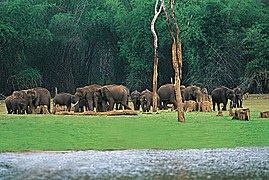 Elephants at Thekkady


 Definitions from Wiktionary
 Media from Wikimedia Commons
 News from Wikinews
 Quotations from Wikiquote
 Texts from Wikisource
 Textbooks from Wikibooks
 Travel guide from Wikivoyage
 Resources from Wikiversity
 Geographic data related to Kerala at OpenStreetMap


Keine Kommentare:
Kommentar veröffentlichen